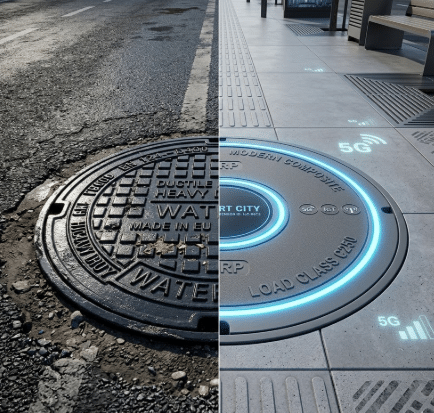
The global procurement of access solutions is no longer a simple matter of selecting the cheapest lid for a hole. As urban populations surge toward 60% of the world’s total by 2030, the subterranean utility networks that power our cities—ranging from high-speed 5G fiber optics to high-pressure water systems—require protection that is as sophisticated as the assets themselves. In 2026, reliability is defined by a material’s ability to withstand extreme dynamic loads, resist chemical degradation, and integrate into data-driven “Smart City” frameworks. This report examines the technical, economic, and safety profiles of ductile iron and composite materials, providing an authoritative framework for decision-makers tasked with building resilient, long-term urban foundations.
The engineering community is currently witnessing a fascinating evolution where traditional metallurgical strength meets the innovative versatility of polymer science. Ductile iron remains a commanding force in the market, particularly for heavy-load highway and industrial contexts, while composite materials—comprising Fiberglass Reinforced Plastic (FRP) and Sheet Molding Compound (SMC)—are racing ahead with a projected CAGR of 5.79% through 2030. The choice between these two is not about finding a “superior” material in a vacuum, but about aligning material properties with the specific environmental stressors and operational requirements of a project. Whether your priority is the F900 extreme-duty rating of an airport taxiway or the non-conductive, theft-proof requirements of a residential smart grid, understanding the microscopic differences between these materials is the first step toward infrastructure excellence.
Ductile Iron: The Traditional Titan of Structural Integrity
Ductile iron, also known as spheroidal graphite iron, remains the industry standard for high-performance applications where structural safety is non-negotiable. Its dominance is rooted in a unique metallurgical breakthrough: the addition of magnesium to molten iron, which transforms sharp graphite flakes into tiny, spherical nodules. These nodules act as internal “crack arrestors,” granting the material a flexibility and tensile strength that traditional gray iron lacks. In 2026, this “bend-but-don’t-break” characteristic is vital for handling the increased dynamic loads of modern logistics, where vehicles can exert impacts up to 1.29 times their static weight. Ductile iron’s ability to absorb these energetic pulses without brittle fracture makes it the only viable choice for the F900 extreme-load environments of airports and docks.
Beyond its physical toughness, ductile iron is favored for its adherence to the most rigorous international benchmarks, such as AASHTO M306 and EN 124-2. In the North American market, AASHTO M306-certified products are mandatory for Department of Transportation (DOT) contracts because they incorporate a 2.5 safety factor, requiring highway covers to withstand a 40,000-pound proof load without permanent deformation. While ductile iron is heavy—typically weighing between 79 kg and 136 kg—this mass provides inherent stability, preventing the “rocking” and “flipping” hazards that lead to fatal traffic accidents. For global projects in 2026, ductile iron represents a legacy of proven fatigue resistance and a 30- to 50-year service life, provided it is protected by modern bitumen or epoxy coatings to mitigate corrosion.
The Composite Revolution: Innovation, Ergonomics, and Security
While iron provides raw strength, composite materials like FRP and SMC are redefining the ergonomics and security of modern infrastructure. The rising demand for composites in 2026 is fueled by three primary advantages: weight reduction, corrosion resistance, and theft deterrence. Composite covers can be up to 70% lighter than their iron counterparts, allowing a single worker to perform maintenance tasks that previously required a two-person crew or heavy lifting equipment. This lightweight nature significantly reduces installation labor costs and, more importantly, minimizes the long-term risk of spinal injuries for municipal workers—a critical factor in the aging workforce landscapes of Europe and North America.
From a security perspective, composites solve one of the most persistent challenges in emerging markets: metal theft. Because composite materials have zero scrap resale value, they are inherently theft-proof, protecting critical subterranean utilities from unauthorized access and preventing the lethal hazard of open pits in city streets. Furthermore, their non-metallic nature makes them the preferred choice for 5G and smart grid deployments, as they do not interfere with wireless signals and provide total electrical insulation, eliminating the risk of stray voltage incidents. In 2026, as cities become more electrified and data-dependent, the non-conductive and RF-transparent properties of composites make them an indispensable component of the “Smart City” ecosystem.
| Feature | Ductile Iron (DI) | Composite (FRP/SMC) | Technical Implication for 2026 |
| Maximum Load | Up to F900 (90 tonnes) | Up to D400 (40 tonnes) | DI is better for heavy-load highways/airports. |
| Material Weight | Heavy (100%) | Ultra-Light (30% of iron) | Composites reduce labor costs and injuries. |
| Corrosion Risk | Moderate (Needs Coating) | Excellent (Natural) | Composites are ideal for coastal/chemical areas. |
| Theft Deterrence | Low (High Scrap Value) | High (Zero Scrap Value) | Composites prevent infrastructure vandalism. |
| Electrical Safety | Conductive | Non-conductive | Composites are safer for electrical/telecom pits. |
| RF Transparency | Blocks signals | Allows signals | Composites are essential for 5G smart grids. |
Standards and Compliance: Navigating EN 124 and AASHTO
The technical divide between ductile iron and composite is most clearly defined in the updated international standards. The European standard EN 124:2015 is divided into material-specific parts: Part 2 for cast iron and Part 5 for composite materials. This allows engineers to compare products on a level playing field of “Load Classes,” ranging from A15 for pedestrian paths to D400 for roadways. In 2026, the transition to these material-specific standards is nearly universal, and procurement teams must demand a Certificate of Conformity (CoC) and a Mill Test Report (MTR) for every batch. These documents provide empirical evidence of load-bearing capacity, permanent set limits, and UV stability—ensuring that your project meets the highest safety benchmarks.
In North American infrastructure, the distinction is even more pronounced. While composites are gaining traction in off-street applications, AASHTO M306 remains the governing standard for covers used in highway environments. This standard currently mandates the use of watertight, pickable cast iron covers for H20 traffic ratings in many jurisdictions, explicitly prohibiting composite lids in specific heavy-duty wastewater contexts. However, the emergence of high-strength, UV-stable resin mixes rated for 50,000-lb loads is beginning to expand the viable use cases for composites beyond sidewalks. For 2026 tenders, verifying that a manufacturer holds ISO 9001 certification and offers third-party testing from organizations like SGS or Bureau Veritas is essential for mitigating municipal liability.
Total Cost of Ownership (TCO) and Sustainability Goals
As we move toward 2030, the economic analysis of manhole covers must shift from “initial purchase price” to “Total Cost of Ownership” (TCO) and “Carbon Scorecards.” While ductile iron covers often have a lower upfront cost, their long-term maintenance requirements—including periodic recoating to prevent rust and the higher labor costs associated with heavy lifting—can make them more expensive over a 50-year lifecycle. Conversely, high-performance composite covers, despite a higher initial price point, offer “payback” within 12 to 24 months through avoided theft, lower equipment rental costs, and significantly shorter lane closures during installation. In 2026, these operational efficiencies are increasingly prioritized by municipal budget planners.
Sustainability is the second pillar of the modern procurement scorecard. Ductile iron is a champion of the circular economy, with modern foundries utilizing up to 85% recycled metal content and producing covers that are 100% recyclable at the end of their service life. However, the high-energy smelting process contributes significantly to carbon emissions. Composite materials, while often harder to recycle traditionally, contribute to sustainability through their lower weight, which drastically reduces the carbon footprint of international transportation and logistics. Furthermore, the development of recycled thermoplastic composites and regenerated resins is allowing manufacturers to meet “embodied carbon” thresholds that are increasingly mandatory in European and North American infrastructure contracts.
2026 Trends: Smart Cities and the IoT-Integrated Future
The most transformative trend for 2026 is the integration of the Internet of Things (IoT) into manhole assemblies. Traditional covers are passive lids; modern “Smart Manhole Covers” are active network endpoints equipped with NB-IoT or 5G sensors. These sensors monitor parameters such as cover displacement, unauthorized opening (theft detection), sewage water levels, and even hazardous gas density. In cities like Dubai and Amsterdam, these systems have reduced the average manual response time to urban flooding or infrastructure damage from two hours to just 15 minutes. Ductile iron provides the ideal robust housing for these sensitive electronics in high-traffic zones, while composites offer the best RF transparency for real-time data transmission.
The future of infrastructure also demands better acoustic management. One of the most frequent citizen complaints in residential areas is the loud, metallic “clacking” of loose manhole covers. In 2026, reliable manufacturers solve this through precision machining—maintaining tolerances of less than 1mm—and the integration of elastomeric gaskets or rubber seals that absorb traffic vibrations. Leading case studies, such as the Singapore Land Transport Authority’s 2020 redesign, achieved a 60% reduction in noise by combining ductile iron with polyurethane damping pads. Whether you choose iron or composite, prioritizing noise-reduction technology is essential for creating harmonious, livable urban environments in the high-density cities of the future.
Conclusion: Engineering a Resilient Urban Foundation
In conclusion, the decision between Ductile Iron vs. Composite for 2026 is a strategic alignment of material science with urban reality. Ductile iron remains the unrivaled titan for the heavy-duty stresses of highways, airports, and freight corridors, where its metallurgical nodularity provides a life-saving safety margin under extreme loads. However, for the majority of urban sidewalk, telecommunications, and smart grid applications, composite materials offer a superior combination of weight reduction, chemical resistance, and inherent security that iron cannot match.
As cities face the increasing pressures of climate change and rapid urbanization, the role of access solutions will only grow in importance. By prioritizing manufacturers who provide transparent certifications (EN 124, AASHTO M306), invest in noise-reduction engineering, and offer IoT-ready designs, procurement specialists can ensure that their infrastructure stands on a foundation of safety and innovation. Ultimately, the partnership with a certified manufacturing partner transforms the procurement of manhole covers from a commodity transaction into a vital investment in the security, silence, and sustainability of the 2026 city.
Frequently Asked Questions (FAQ)
1. Is Ductile Iron vs. Composite a simple choice based on price?
No. While ductile iron often has a lower initial price, the Total Cost of Ownership (TCO) for composites is often lower due to reduced installation labor, zero theft risk, and lower maintenance requirements. For 2026, procurement should focus on the 50-year lifecycle cost rather than just the unit price.
2. Can composite manhole covers handle heavy highway traffic?
Yes, but they must be specifically certified to EN 124 Class D400 or meet equivalent AASHTO proof-load requirements. While ductile iron is still preferred for extreme F900 loads (airports), modern high-strength composites are now rated for 50,000-lb vehicular loads in many urban road contexts.
3. Why are composite covers better for 5G and telecommunications projects?
Composite materials are non-metallic and RF-transparent, meaning they do not block radio waves. This allows IoT sensors and 5G equipment located in underground chambers to transmit data seamlessly to the surface, which is impossible with traditional iron covers.
4. How does the weight of Ductile Iron vs. Composite affect worker safety?
Ductile iron is heavy (up to 136 kg), posing a high risk of spinal injuries during manual lifting. Composite covers are up to 70% lighter, allowing a single worker to safely remove the lid with ergonomic tools, significantly reducing workplace compensation claims and labor costs.
5. What certifications are essential to verify for 2026 infrastructure tenders?
Always demand a Certificate of Conformity (CoC) and an EN 10204 Type 3.1 or 3.2 Mill Test Report (MTR). These verify compliance with standards like EN 124:2015 (Parts 2 or 5), AASHTO M306, and ISO 9001, ensuring the product meets stated load ratings and safety benchmarks.