The global landscape of urban infrastructure is underpinned by a complex web of technical specifications that ensure public safety and operational longevity. Among these, manhole cover standards in different countries serve as the primary regulatory framework for access solutions, transforming a simple industrial casting into a high-performance safety device. For civil engineers, municipal planners, and international contractors, navigating these standards is not merely a matter of compliance but a fundamental requirement for risk mitigation. A miscalculation in load rating or material specification can lead to catastrophic structural failure, high municipal liability, and the premature degradation of critical utility networks. As cities transition toward “Smart City” models, the role of standardized access points—protecting everything from high-speed fiber optics to high-pressure water mains—has become more vital than ever before.
The evolution of these standards reflects regional traffic patterns, climatic challenges, and industrial philosophies. While the European EN 124 series has become the “lingua franca” of the global industry, the North American AASHTO system, the Australian AS 3996, and various national standards like China’s GB/T or India’s IS 12592 offer unique approaches to engineering resilience. Reliability in the modern procurement sector is defined by a manufacturer’s ability to harmonize these diverse requirements into a cohesive infrastructure solution. This guide provides a comprehensive analysis of the most influential manhole cover standards worldwide, offering the technical depth needed to make informed decisions for large-scale international projects and ensuring that the foundation of our cities remains secure and silent.
The European Benchmark: Navigating the EN 124 Series
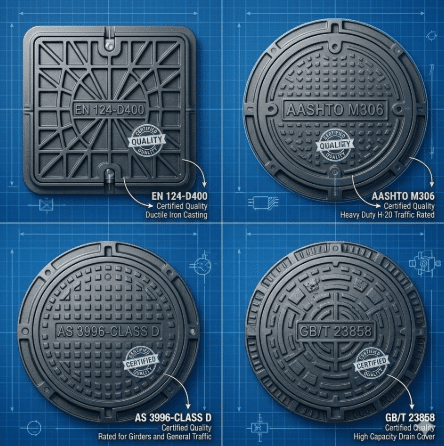
The European standard EN 124 is currently the most comprehensive and widely adopted framework globally, influencing infrastructure projects across Europe, the Middle East, and parts of Asia. Originally introduced in 1994 and significantly updated in 2015, this standard is divided into six distinct parts that cater to the diversification of modern materials. Part 1 sets the general principles, while Parts 2 through 6 provide granular specifications for cast iron, steel, reinforced concrete, composite materials, and plastics. This material-specific approach allows engineers to select the most appropriate substrate—such as lightweight FRP for telecommunications or heavy-duty ductile iron for highways—while ensuring that each meets a unified safety benchmark for its intended environment.
A defining feature of EN 124 is its classification system, which categorizes covers into six classes based on their load-bearing capacity in kilonewtons (kN). For instance, Class A15 is strictly for pedestrian zones, while Class D400 is the industrial standard for main carriageways and high-traffic urban centers. The verification process under EN 124 is rigorous, requiring manufacturers to obtain a Certificate of Conformity (CoC) from accredited third-party bodies such as BSI (Kitemark), SGS, or Bureau Veritas. This certification ensures that every production batch undergoes proof-load testing and dimensional inspection, providing a “gateway to trade credibility” that is essential for qualifying for government and municipal tenders worldwide.
| EN 124 Class | Minimum Test Load | Typical Installation Environments | Technical Application |
| A15 | 15 kN (1.5 Tons) | Pedestrian zones, green spaces, and private gardens | Light-duty; primarily for foot traffic. |
| B125 | 125 kN (12.5 Tons) | Footways, car parks, and pedestrian precincts | Medium-duty; for light vehicular access. |
| C250 | 250 kN (25 Tons) | Kerbside channels of roads, extending 0.5m into the road | Gully tops with lateral traffic stress. |
| D400 | 400 kN (40 Tons) | Main carriageways, hard shoulders, and motorways | Heavy-duty; the urban/highway standard. |
| E600 | 600 kN (60 Tons) | Docks, container terminals, and industrial areas | High-load; for high wheel-load vehicles. |
| F900 | 900 kN (90 Tons) | Aircraft pavements, runways, and extreme load sites | Extreme-duty; maximum integrity required. |
The American Paradigm: AASHTO M306 and ASTM Standards
In North America, the procurement of access covers for highway and drainage systems is governed primarily by the AASHTO M306 standard, developed by the American Association of State Highway and Transportation Officials. Unlike the EN 124’s multi-material approach, AASHTO M306 is specifically designed for gray and ductile iron castings, with a heavy emphasis on structural performance under high-speed vehicular traffic. The hallmark of the AASHTO standard is its conservative engineering; it incorporates a 2.5 safety factor into its proof-load testing, requiring standard highway covers to withstand a 40,000-pound (approx. 178 kN) load applied to a 9×9 inch area without permanent deformation exceeding 3.2 mm. This high threshold makes AASHTO-certified products mandatory for Department of Transportation (DOT) and state-level infrastructure contracts across the United States.
The American system also relies on ASTM (American Society for Testing and Materials) standards to specify metallurgical quality. ASTM A48 is the go-to standard for gray iron castings, while ASTM A536 governs ductile iron, specifying the precise chemical composition and tensile strength required to prevent brittle fractures. For procurement specialists, verifying the “Nodularity” of ductile iron on the Mill Test Report (MTR) is a critical step in ensuring compliance with AASHTO M306. Furthermore, the standard includes stringent requirements for “machined bearing surfaces” to prevent the rocking and noise pollution that can lead to frame failure on high-speed motorways, ensuring a tight fit with tolerances often tighter than 1.6 mm.
The Australian Rigor: AS 3996 and Environmental Sealing
Australia’s approach to manhole cover standards, codified in AS 3996:2019, is often regarded as one of the most rigorous in the world. Similar to the European system, AS 3996 classifies covers into seven load classes from A to G, with Class D (240 kN ultimate limit state design load) being the common requirement for major roads and freeway shoulders. However, the Australian standard distinguishes itself through a unique focus on environmental sealing and slip resistance. In a continent prone to extreme rainfall events and flash flooding, the standard places a high premium on “gas and watertight” features and “anti-dislodgment” mechanisms that prevent the “blow-offs” common during sewer surcharges.
Testing under AS 3996 involves not only static load testing but also “Serviceability Testing,” where the load is repeated for five cycles to measure fatigue resistance and permanent set against strict criteria. For infrastructure managers in Australia, the presence of the “AS3996:2019” marking on the top surface is a non-negotiable safety requirement. This standard also explicitly covers polymeric materials for lower load classes, but limits their use in extreme load environments (Classes E, F, and G), ensuring that the most critical heavy-duty points are protected by high-strength ductile iron or reinforced concrete. This focus on specialized environmental protection makes Australian-standard covers a preferred choice for flood-prone regions globally.
The Asian Context: China’s GB/T and India’s IS Standards
As the world’s largest producer of municipal castings, China has established the GB/T 23858 standard, which provides a detailed classification for city infrastructure. This standard divides manhole covers into three primary grades—Light, Ordinary, and Heavy—which align closely with the kN load ratings found in EN 124 (e.g., 400 kN for heavy-duty roadways). The recent modernization of the Chinese market, driven by “Sponge City” construction and urban renewal initiatives, has pushed national enterprises to adopt higher-value production methods, including automated molding and CNC machining, to meet both domestic GB/T and international EN 124 requirements. This dual-compliance capability allows Chinese foundries to serve as a major hub for global infrastructure supply chains.
In India, the IS 12592 standard governs precast and cast iron covers, placing specific emphasis on water-tightness and cover-frame locking to prevent dislodgement—a vital feature for preventing accidents in monsoon-prone cities. The standard categorizes covers into Light, Medium, Heavy, and Extra Heavy Duty, and is a staple in public works tenders across South Asia. Reliable Indian manufacturers often complement IS 12592 with international certifications like the BSI Kitemark to enhance their export appeal. For global buyers, understanding the interplay between these national standards and international benchmarks is key to identifying suppliers who can deliver technical precision at a competitive cost.
Regional Adaptations: Middle East and Africa Specifics
The Middle East and Africa (MEA) region presents a unique engineering challenge due to extreme thermal fluctuations, shifting desert sands, and corrosive coastal environments. While EN 124 is the dominant load-bearing standard, local adaptations are frequently mandatory. In Saudi Arabia, the Ministry of Municipal and Rural Affairs (MOMRA) mandates that infrastructure materials—especially manhole covers—possess exceptional heat resistance and anti-slip properties to ensure safety in 50°C+ temperatures. Similarly, the Abu Dhabi Manhole Cover Design Policy outlines mandatory guidelines for aesthetic integration, requiring recessed “in-fill” covers that allow the utility access point to match the surrounding historic paving or high-end urban plazas.
Theft prevention is another critical regional adaptation in MEA. Driven by the high scrap resale value of metals, many MEA municipalities now specify “theft-deterrent engineering,” such as non-metallic composite covers or integrated locking mechanisms. These systems range from simple stainless steel bolts to sophisticated “Cam locks” that secure the cover to the frame, ensuring that critical underground assets remain protected from vandalism. Furthermore, in regions prone to sand accumulation, “self-cleaning” designs and sediment traps are highly valued, preventing debris from wedging the cover in place and ensuring that utility workers can maintain easy access even after sandstorms.
Global Testing and Quality Assurance Protocols
Regardless of the specific standard, the verification of a manhole cover’s reliability rests on rigorous batch-level testing and transparent documentation. Every reliable manufacturer must provide a Mill Test Report (MTR) and a Certificate of Conformity (CoC) that provide traceable evidence of material integrity. These reports detail the chemical composition (specifically the magnesium content for ductile iron), tensile strength, and elongation results for each melt batch. In high-stakes infrastructure, an “EN 10204 Type 3.2” certificate is the gold standard, requiring an independent third-party inspector to witness the tests and co-sign the documentation, providing absolute certainty for critical applications like airport runways or nuclear power plants.
Modern quality assurance has also embraced digital monitoring through the Internet of Things (IoT). “Smart Manhole Covers,” increasingly specified in cities like Dubai and Amsterdam, are equipped with sensors that monitor cover status, vibration levels, and even subsurface gas density. These sensors feed real-time data into centralized municipal platforms, allowing for “Predictive Maintenance” and rapid response times (often reduced from hours to 15 minutes) in cases of displacement or flooding. As we move toward 2026 and beyond, the definition of a “standardized” manhole cover is expanding to include not just physical load classes, but also digital interoperability and environmental intelligence.
| Quality Check | Technical Metric | Objective of the Standard |
| Proof Load | 400kN (D400) or 40,000lb (AASHTO) | Validate structural safety under traffic. |
| Permanent Set | ≤ 1/100 diameter (EN) or 3.2mm (AASHTO) | Prevent rocking and eventual “flipping”. |
| Chemical Analysis | Nodularity > 80% (Ductile Iron) | Ensure material flexibility and impact resistance. |
| Dimensional Fit | Tolerance ≤ 1mm | Minimize noise and metal-on-metal wear. |
| Slip Resistance | Raised Pattern (RP) height/texture | Protect pedestrians and cyclists in wet weather. |
Conclusion: Securing Global Infrastructure Foundations
In conclusion, the study of manhole cover standards in different countries reveals a global consensus on safety and a diverse array of technical solutions to regional challenges. Whether a project adheres to the multi-material versatility of EN 124, the heavy-traffic durability of AASHTO M306, or the environmental focus of AS 3996, the objective remains the same: to create a silent, stable, and resilient urban foundation. For procurement specialists and engineers, the path to reliability lies in a deep understanding of these specifications and a commitment to rigorous certification verification and batch-level traceability.
As urban density increases and the pressures of climate change and evolving security threats grow, the role of high-performance access solutions will only expand. By prioritizing manufacturers who innovate in areas such as noise reduction, anti-theft locking systems, and IoT-ready smart monitoring, civil authorities can build more harmonious and secure urban environments. Ultimately, the partnership between project managers and certified manufacturers transforms the procurement of manhole covers from a commodity purchase into a strategic investment in the future of the city.
Frequently Asked Questions (FAQ)
1. Which manhole cover standard is most widely used for international projects?
The EN 124 standard is the most globally recognized benchmark, particularly in Europe, the Middle East, and Asia. It is valued for its material-specific parts and its clear A15 to F900 classification system which helps engineers match load ratings to specific installation zones.
2. What is the main difference between EN 124 and AASHTO M306?
EN 124 focuses on a categorization system (A15-F900) for all materials, while AASHTO M306 is specifically for iron castings used in North American highways. AASHTO includes a higher 2.5x safety factor and a specific 40,000-pound proof-load test that is mandatory for U.S. DOT contracts.
3. How do Australian manhole cover standards (AS 3996) compare?
AS 3996 is considered one of the toughest standards globally, with a strong focus on slip resistance and environmental sealing. It uses a different class system (A-G) and includes “Serviceability Testing” to replicate the daily wear of real-world traffic over thousands of cycles.
4. Are composite manhole covers certified under the same standards as iron ones?
Yes. Under EN 124:2015, Part 2 governs cast iron while Part 5 specifically governs composite materials. This allows engineers to compare the load-bearing performance of different materials using the same class system (e.g., a D400 composite cover vs. a D400 iron cover).
5. Why are manhole covers in the Middle East often customized?
Middle Eastern infrastructure requires adaptations for extreme heat, sandstorms, and aesthetic integration. Saudi Arabia (MOMRA) and Abu Dhabi (DMT) have specific guidelines for thermal stability, anti-slip patterns, and recessed designs to preserve cultural motifs and urban appearance