Infrastructure projects today face higher demands than ever before. Roads carry heavier trucks, and cities need systems that last for decades. This has led many procurement specialists and engineers to rely on Ductile Iron Grade 500/7. Also known as EN-GJS-500-7 or GGG50, this material is famous for its “bend-but-don’t-break” quality.
Unlike older materials like grey cast iron, which can be brittle and snap under pressure, ductile iron uses advanced metallurgy to handle sudden impacts. Grade 500/7 is often considered the “middle grade” that offers high strength without losing its ability to stretch. As we build smarter and more resilient cities, understanding these specifications is key to choosing products that reduce liability and maintenance costs.
What Does “500/7” Actually Mean?
The name of this grade actually tells you its two most important mechanical properties. This simple naming system helps engineers quickly identify what the material can handle during the design phase.
- The “500”: This represents the Minimum Tensile Strength. It means the iron can withstand a pulling force of at least 500 Megapascals ($MPa$) before it breaks. This high strength allows manufacturers to design parts that are thinner and lighter than grey iron but just as strong.
- The “7”: This represents the Minimum Elongation. This is the most vital part for safety. It means the material can stretch by at least 7% of its length before it snaps. This flexibility acts as a safety margin; if a manhole cover is overloaded, it will bend rather than shatter instantly.
| Property | Minimum Requirement | Typical Industrial Range |
| Tensile Strength | 500 MPa | 500 – 550 MPa |
| 0.2% Yield Strength | 320 MPa | 320 – 380 MPa |
| Elongation (A5) | 7% | 7% – 12% |
| Brinell Hardness | 170 – 230 HB | 170 – 241 HB |
Global Equivalents: Different Names, Same Quality
Because the supply chain for infrastructure is global, you might see this material listed under different names depending on the country of origin. It is important for procurement teams to know these equivalents to ensure they are getting the correct specification for their tender.
- Europe (EN 1563): Known as EN-GJS-500-7. This is the most common standard used in international projects.
- Germany (DIN 1693): Often called GGG50. Many older technical drawings still use this name.
- United States (ASTM A536): The closest equivalent is 70-50-05. While slightly different in numbers, it serves the same heavy-duty purposes.
- China (GB/T 1348): Known as QT500-7. “QT” stands for “Qiu Tie,” which is the Chinese term for ductile iron.
- International (ISO 1083): Designated as GRADE 500-7.
Knowing these equivalent grades allows you to source materials from reliable foundries worldwide while maintaining consistent project quality.
The Science of Strength: Microstructure and Nodularity
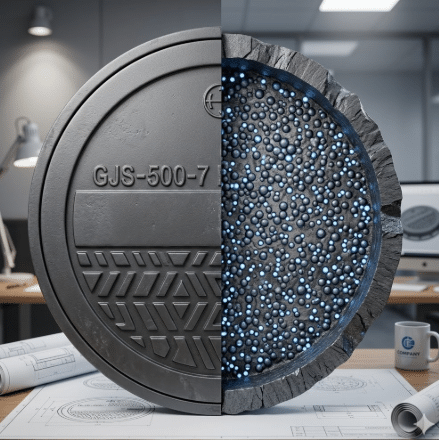
The secret to why Grade 500/7 performs so well lies in its microscopic structure. Foundries achieve this through a process called “magnesium treatment” or “nodularization”.
In standard grey iron, carbon forms into sharp flakes. These flakes act like tiny cracks inside the metal, making it easy to break. In Ductile Iron Grade 500/7, foundries add magnesium to the liquid iron. This causes the carbon to form into small, smooth spheres or nodules. These spheres do not create stress points. Instead, they allow the iron to “flow” and absorb energy.
Engineers look at the Nodularity Rate to judge quality. For high-stakes parts like water valves or highway manhole covers, a nodularity rate of 80% or higher is usually required. This ensures the material has the impact resistance needed for heavy traffic.
Matrix Composition: Ferrite and Pearlite
Grade 500/7 usually has a mixed matrix of Ferrite and Pearlite.
- Ferrite is soft and very ductile. It helps with stretching and shock absorption.
- Pearlite is hard and strong. It provides the high tensile strength and wear resistance. By balancing these two (often around a 50:50 ratio), manufacturers create a material that is tough enough for the road but easy to machine in the factory.
Why Grade 500/7 is the Standard for D400 Manhole Covers
One of the most famous uses for Ductile Iron Grade 500/7 is the production of D400 manhole covers. These covers are designed for main city roads and highways where they must support up to 40 tonnes of weight.
There are several engineering reasons for this choice:
- Weight Reduction: Because Grade 500/7 is so strong, manufacturers can design covers that are 30% lighter than grey iron versions. This makes them safer for workers to lift and cheaper to ship internationally.
- Impact Resistance: Vehicles hitting a cover at high speed create “dynamic loads”. Grade 500/7 absorbs these shocks without cracking.
- Noise Damping: This iron grade has a natural ability to dampen vibrations. When combined with precision machining (gaps of ≤1mm) and rubber gaskets, it can reduce street noise by up to 60%.
- Consistent Quality: Modern foundries use automated molding and CNC machining to ensure every GJS-500-7 casting fits perfectly into its frame, preventing the “rattling” that causes road wear.
How to Verify Quality: The MTR Checklist
In the B2B procurement world, you cannot just take a manufacturer’s word for it. You must verify the material through a Mill Test Report (MTR). This document acts as the material’s “report card.”
When you receive a batch of Grade 500/7 parts, use this verification checklist:
- Heat Number Match: Check that the alphanumeric “Heat Number” cast into the physical iron matches the one printed on the MTR. This ensures traceability back to the specific furnace melt.
- Chemical Composition: Verify the elements are within typical ranges. For example, Silicon should be around 2.3–3.1% to stabilize the structure, and Magnesium should be around 0.03–0.07% to ensure proper nodularity.
- Mechanical Results: The report must show the actual test results for that batch. Tensile strength must be ≥ 500 MPa, and elongation must be ≥ 7%.
- Certificate Type: For critical infrastructure, look for EN 10204 Type 3.1 (certified by the factory) or Type 3.2 (verified by an independent third party like SGS or BSI).
2026 Trends: Sustainability and Smart Integration
The future of Ductile Iron Grade 500/7 is both “Green” and “Smart.”
Environmental Sustainability: Ductile iron is a champion of the circular economy. Modern foundries often use up to 85% to 90% recycled scrap metal in their melts. At the end of its 30- to 50-year lifespan, a Grade 500/7 manhole cover is 100% recyclable. This makes it a preferred choice for projects aiming for LEED or Green Building certifications.
Smart Infrastructure: We are seeing a surge in “Smart Manhole Covers.” Because Grade 500/7 provides a robust and stable housing, cities are now embedding IoT sensors into the iron castings. These sensors use NB-IoT or 5G networks to monitor water levels, detect unauthorized opening (theft), and even track hazardous gas buildup. This allows cities to respond to flooding in just 15 minutes, rather than hours.
Conclusion
Ductile Iron Grade 500/7 (EN-GJS-500-7) is much more than just “iron.” It is a highly engineered material that solves the most difficult challenges in urban development. By providing the strength of steel with the long-lasting nature of iron, it ensures that city roads remain safe, quiet, and stable for decades.
For procurement professionals and engineers, Grade 500/7 is a safe investment. It meets the toughest international standards, supports the growth of smart city technology, and fits perfectly into global sustainability goals. When you choose Grade 500/7, you are choosing a material that is built to endure the stresses of the twenty-first century and beyond.
Frequently Asked Questions (FAQ)
1. Can I use Grade 500/7 for airport runways? While Grade 500/7 is excellent for city roads (D400), airports typically require the F900 load class. In those cases, manufacturers may still use Ductile Iron, but they might use a higher-strength grade like 600/3 or a thicker design to handle the extreme 90-tonne loads.
2. What is the difference between GGG50 and GGG40? GGG50 (Grade 500/7) is stronger but slightly less flexible than GGG40 (Grade 400/15). GGG40 is “purely ferritic,” which means it stretchers more (up to 15-18%) but has lower strength. GGG50 is usually preferred for traffic-heavy road applications.
3. Does this material require a coating to prevent rust? Yes. While ductile iron resists corrosion better than steel, it will still oxidize if left untreated. Most municipal products are treated with two layers of black bitumen or high-performance epoxy to ensure a 50-year service life.
4. Why is the 7% elongation so important for road safety? The 7% elongation means the iron is “ductile.” If a heavy vehicle hits a cover with more force than it was designed for, the iron will bend or deform instead of shattering like a piece of glass. This prevents sudden, dangerous open pits in the middle of a busy road.
5. How do I know if my supplier is really providing Grade 500/7? Always request an EN 10204 3.1 Mill Test Report. Check that the heat number on the report matches the stamp on the iron. Look for the tensile strength ($>500\text{ MPa}$) and elongation ($>7\%$) results. Reputable manufacturers will also have ISO 9001 quality certificates.