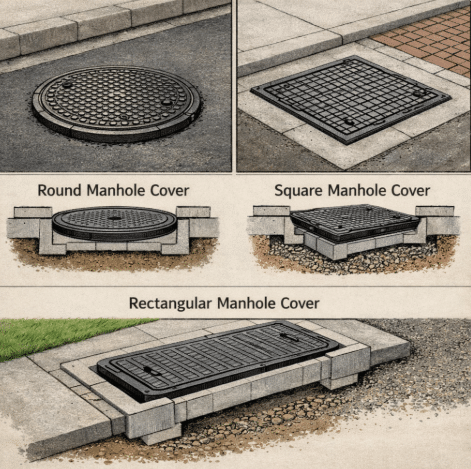
Manhole covers are a familiar yet often overlooked component of modern urban infrastructure. Found on roads, sidewalks, industrial zones, and residential areas, they protect access points to underground utilities such as sewage systems, drainage networks, telecommunications, and electrical lines. A common question asked by engineers, students, and the general public alike is: why are manhole covers round, square, or rectangular? The answer is not merely aesthetic but rooted in engineering principles, safety requirements, manufacturing efficiency, and installation conditions. Understanding the rationale behind different manhole cover shapes helps municipalities, contractors, and buyers select the most appropriate solutions for specific applications.
The Engineering Logic Behind Manhole Cover Shapes
The shape of a manhole cover directly affects its structural behavior, safety performance, and ease of use. Engineers consider multiple factors when selecting a shape, including load distribution, resistance to displacement, handling during installation, and compatibility with surrounding surfaces. Circular, square, and rectangular manhole covers each offer distinct mechanical advantages depending on the environment in which they are installed. These shapes are not arbitrary; they result from decades of infrastructure development, standardization, and real-world performance data. Choosing the correct shape reduces maintenance costs, enhances road safety, and ensures long-term durability under traffic and environmental stress.
Why Manhole Covers Are Round
Round manhole covers are the most widely recognized and commonly used design worldwide. The primary reason for this popularity lies in safety and structural efficiency. A round cover cannot fall through its opening, regardless of how it is rotated, which significantly reduces the risk of accidents during installation or maintenance. From a structural perspective, circular shapes distribute loads evenly across the entire surface, making them ideal for roads with heavy vehicular traffic. This uniform stress distribution minimizes weak points and reduces the likelihood of cracking or deformation. Additionally, round covers are easier to manufacture and install because they do not require precise alignment, making them cost-effective for large-scale municipal projects.
Why Square Manhole Covers Are Used
Square manhole covers are commonly found in sidewalks, residential areas, and utility corridors where access convenience is a priority. One key advantage of square designs is that they maximize usable opening space, allowing easier entry for maintenance personnel and equipment. Square covers are often preferred in environments with lower traffic loads, where extreme structural performance is not required. However, because square covers can theoretically fall through their openings if improperly handled, they typically include supporting frames or locking mechanisms. Their straight edges also align well with paving stones, tiles, and concrete slabs, making them visually and structurally compatible with pedestrian areas.
Why Rectangular Manhole Covers Exist
Rectangular manhole covers are primarily used for linear utility systems, such as drainage channels, cable trenches, and stormwater collection systems. These covers provide extended access along a specific direction, making inspection and maintenance more efficient. Rectangular designs are particularly common in industrial zones, ports, airports, and large commercial developments where infrastructure systems run parallel to roads or buildings. While they require more precise installation and reinforcement to handle loads effectively, rectangular manhole covers offer unmatched practicality for specialized applications. Their design allows engineers to optimize access without compromising surface functionality.
Load Distribution and Structural Performance
Load-bearing capacity is a critical consideration in manhole cover design. Round covers excel in distributing pressure evenly, which is why they dominate high-traffic environments such as highways and arterial roads. Square and rectangular covers, by contrast, experience higher stress concentrations at corners, requiring thicker materials or reinforced frames to achieve comparable performance. International standards such as EN 124 classify manhole covers based on load capacity rather than shape, but shape plays a significant role in how effectively a cover meets these classifications. Selecting the appropriate shape ensures compliance with safety regulations and extends the service life of the infrastructure.
Installation, Handling, and Maintenance Considerations
Ease of handling is another important factor influencing manhole cover shape. Round covers can be rolled into position, reducing physical strain and the risk of injury for workers. Square and rectangular covers, while heavier and more difficult to maneuver, offer practical advantages in controlled environments where alignment and access precision are essential. Maintenance frequency, available equipment, and labor conditions all influence the choice of shape. Municipalities often standardize shapes across regions to streamline training, inventory management, and replacement processes.
Urban Design and Aesthetic Integration
In modern urban planning, aesthetics matter alongside functionality. Square and rectangular manhole covers integrate seamlessly with architectural layouts, paving patterns, and modular construction systems. Round covers, while less visually aligned with geometric paving, remain dominant in roadways due to their superior safety performance. Increasingly, cities are combining functional design with customized surface patterns, logos, and textures to enhance visual cohesion without compromising structural integrity.
Choosing the Right Manhole Cover Shape
Selecting the correct manhole cover shape requires evaluating traffic load, installation location, access requirements, and regulatory standards. Engineers must balance safety, cost, durability, and usability. In many cases, the choice is dictated by local regulations or long-standing engineering practices. However, understanding the strengths and limitations of each shape allows decision-makers to optimize infrastructure performance and lifecycle costs.
Conclusion
The reason manhole covers are round, square, or rectangular is rooted in practical engineering logic rather than tradition or appearance. Round covers offer unmatched safety and load distribution, making them ideal for roads and heavy traffic areas. Square covers provide efficient access and compatibility with pedestrian environments, while rectangular covers serve specialized linear infrastructure needs. Each shape plays a vital role in supporting modern urban systems. By understanding these design principles, municipalities, engineers, and buyers can make informed choices that enhance safety, efficiency, and long-term value in infrastructure projects.
Frequently Asked Questions (FAQ)
1. Why are most manhole covers round instead of square?
Because round covers cannot fall into their openings and distribute loads evenly, making them safer and stronger.
2. Are square manhole covers unsafe?
Not necessarily. When properly designed and installed, square covers are safe for low-traffic and pedestrian areas.
3. Why are rectangular manhole covers used in drainage systems?
They provide extended access along linear utility channels, making maintenance more efficient.
4. Does manhole cover shape affect load capacity?
Yes. Shape influences stress distribution, though final load capacity is determined by material and design standards.
5. Can different shapes meet the same international standards?
Yes. Round, square, and rectangular covers can all meet standards like EN 124 if properly engineered.
Meta Description (≈150 characters)
SEO-Friendly URL
/
Primary Keyword
Why are round
Related Keywords
- round vs square manhole covers
- rectangular manhole cover applications
- manhole cover design explained
1:1 SEO Thumbnail Image Prompt
Image Generation Prompt (English):
Square 1:1 educational illustration showing round, square, and rectangular manhole covers installed in different urban environments, clear labels, engineering diagram style, realistic textures, neutral industrial colors.
If you want, I can next:
- Convert this article into a pillar page with internal linking strategy
- Adapt it into product-category SEO content
- Localize it for EU, Middle East, or US infrastructure markets
Just indicate the next step.