The global landscape of municipal engineering is currently undergoing a historic transformation, driven by the dual pressures of unprecedented urbanization and the need for smarter, more resilient infrastructure. Within this context, the “access point”—the humble manhole cover—serves as the vital interface between the surface environment and the complex subterranean utility networks that power modern life. While the market has seen an influx of innovative materials like Fiber Reinforced Plastic (FRP) and advanced polymer composites, ductile iron continues to hold a commanding 46% share of the global market. This enduring dominance is not merely a result of industrial inertia but is rooted in the material’s unique ability to harmonize extreme structural strength with mechanical flexibility. As cities transition toward “Smart City” models, the role of these durable covers becomes even more critical, ensuring that high-speed utility assets remain protected under decades of intense vehicular stress and environmental degradation.
Reliability in the twenty-first-century procurement sector is defined by the Total Cost of Ownership (TCO) and the mitigation of municipal liability. For civil engineers and international contractors, choosing a material that can endure the dynamic impact of modern logistics—where a single vehicle can exert loads 1.29 times its static weight—is a fundamental requirement for public safety. Ductile iron, also known as spheroidal graphite iron, represents the pinnacle of metallurgical engineering for heavy-duty infrastructure. Its widespread adoption in high-traffic corridors, airport taxiways, and industrial docks is a testament to its unrivaled performance in safety-critical environments. This guide delves into the specific metallurgical properties, international standards, and innovative design features that explain why ductile iron remains the gold standard for global infrastructure projects.
The Metallurgical Breakthrough: Spheroidal Graphite and Ductility
The primary differentiator that elevates ductile iron above traditional gray cast iron is its microscopic structural composition. While gray iron is valued for its compressive strength, its internal graphite is arranged in sharp, interconnected flakes that act as stress concentrators, making the material inherently brittle and prone to fracture under impact. In contrast, the manufacturing process for ductile iron involves the precise addition of magnesium to the molten iron. This chemical intervention transforms the graphite into tiny, spherical nodules. These nodules act as “crack arrestors,” allowing the metal to yield and deform slightly without failing—a property known as ductility. This microscopic evolution grants the material an exceptional strength-to-weight ratio and a tensile strength that rivals many structural steels, making it the preferred choice for areas subject to heavy dynamic loads.
From an engineering perspective, this “bend-but-don’t-break” characteristic is the cornerstone of road safety. In high-speed highway environments, manhole covers are subjected to constant vibration and sudden, high-impact shocks from heavy goods vehicles (HGVs). A brittle material like gray iron or lower-grade concrete might develop internal micro-cracks that lead to catastrophic collapse over time. However, a ductile iron cover, specifically those graded as GGG50 or higher, can absorb these energetic pulses and distribute the stress evenly across the frame assembly. This structural resiliency significantly reduces the risk of “flipped” or dislodged covers, which are primary causes of fatal traffic accidents. For global procurement teams, verifying the “Nodularity” of the iron through a Mill Test Report (MTR) is a critical step in ensuring the safety of the city’s foundation.
Unrivaled Load-Bearing Performance: Navigating EN 124 and AASHTO
The structural capability of a manhole cover is validated through rigorous adherence to international load-bearing standards, where ductile iron consistently outperforms alternative materials. The European Standard EN 124:2015 provides a comprehensive classification system, ranging from A15 for pedestrian zones to F900 for extreme-load environments like aircraft pavements. Ductile iron is uniquely capable of meeting the requirements of Classes D400 through F900, carrying loads up to 90 tonnes (900 kN) with ease. While composite materials are making strides in pedestrian and residential areas (Classes A15 to B125), they often struggle to maintain structural integrity in the heavy-duty, high-frequency traffic zones where ductile iron excels.
| Load Class | Minimum Test Load (kN) | Primary Material | Typical Application |
| D400 | 400 kN (40 Tons) | Ductile Iron | Main roads, highways, and motorways. |
| E600 | 600 kN (60 Tons) | Ductile Iron | Docks, industrial yards, and loading bays. |
| F900 | 900 kN (90 Tons) | Ductile Iron | Airports, military bases, extreme loads. |
In North American markets, the AASHTO M306 standard sets an even higher benchmark for reliability, incorporating a 2.5 safety factor into its testing protocols. For highway-grade covers, AASHTO requires a 40,000-pound proof load to be applied to a 9×9 inch area, a test that must result in no permanent deformation exceeding 3.2 mm. Ductile iron’s ability to pass these “destructive” proof-load tests while remaining lightweight enough for manual handling makes it mandatory for Department of Transportation (DOT) and state-level infrastructure contracts. This technical dominance ensures that as vehicular weights increase due to the rise of electric vehicles (EVs) and heavy logistics fleets, the ductile iron covers already installed will continue to provide a safe surface for decades to come.
Longevity and Environmental Stability: The 50-Year Asset
The service life of infrastructure components is a critical metric for municipal budget planning, and ductile iron offers an exceptional 30- to 50-year lifespan under normal operating conditions. Unlike steel, which is highly susceptible to rapid oxidation and rust, or concrete, which can crumble under freeze-thaw cycles, ductile iron possesses a natural resistance to atmospheric corrosion. Leading manufacturers enhance this durability by applying high-performance bitumen or epoxy coatings, which act as a barrier against the corrosive hydrogen sulfide (H2S) gases often found in sewer systems. This chemical stability ensures that the cover maintains its structural thickness and seat integrity throughout its service life, reducing the need for expensive emergency replacements.
Furthermore, the environmental stability of ductile iron is highlighted by its performance in extreme climates. In regions with significant temperature fluctuations, such as the Middle East or Northern Europe, materials undergo substantial thermal expansion and contraction. Ductile iron’s coefficient of thermal expansion is well-matched with the surrounding asphalt and concrete bedding, minimizing the risk of the frame loosening or “settling”—a phenomenon that leads to noise pollution and road surface degradation. Moreover, its high fatigue resistance means that it can withstand millions of traffic “cycles” without losing its mechanical properties. For the procurement specialist, this long-term reliability translates into a significantly lower annualized cost compared to lower-cost materials that may require replacement every 5 to 10 years.
Innovation in Safety: Noise Reduction and Anti-Theft Engineering
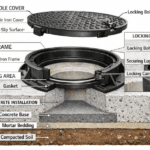
Modern urban governance demands that infrastructure be not only strong but also harmonious with the residential environment. One of the most frequent complaints regarding manhole covers is the loud, metallic “clacking” or “rattling” sound generated by passing vehicles. Reliable ductile iron manufacturers solve this through precision machining of the frame and cover seating surfaces, maintaining tolerances of ≤1mm. Additionally, the integration of high-performance elastomeric gaskets and neoprene seals has revolutionized the stability of ironwork. A prominent case study from Singapore’s Land Transport Authority demonstrated that a triple-seal system—combining rubber gaskets, beveled edges, and locking bolts—achieved a 60% reduction in noise levels at busy urban intersections.
Security is another area where ductile iron continues to innovate. In many emerging markets, the high scrap value of traditional iron makes manhole covers a frequent target for theft, creating lethal hazards for motorists. Reliable manufacturers address this by integrating sophisticated anti-theft mechanisms into their designs. These include “McGard ManLocks” with unique patterned bolt heads, hinged designs that permanently anchor the cover to the frame, and internal “cam locks” that require specialized tools for access. While composite materials solve this issue by having zero scrap value, the security-enhanced ductile iron cover remains the preferred choice for high-security environments like airports and telecommunications hubs, where the physical weight and mechanical lock provide a dual deterrent against unauthorized access.
Sustainability and the Circular Economy
In an era of stringent environmental regulations, the sustainability profile of infrastructure materials is under increased scrutiny. Ductile iron is a champion of the circular economy, as it is 100% recyclable at the end of its multi-decade service life. Most modern foundries utilize up to 85% recycled scrap metal content in their melts, significantly reducing the “embodied carbon” of the final product. While the smelting process for iron is energy-intensive, the material’s long lifespan—often double or triple that of its competitors—means that its total carbon footprint over the asset’s lifecycle is highly competitive. For municipalities striving to meet LEED or Green Building certifications, the recyclability of ductile iron access covers provides a measurable contribution to their sustainability goals.
The future of ductile iron also includes the integration of the Internet of Things (IoT). “Smart Manhole Covers” equipped with NB-IoT sensors are being deployed in cities like Dubai and Amsterdam to monitor wastewater levels, gas density, and unauthorized opening. Ductile iron provides the ideal robust housing for these sensitive electronics, protecting them from the extreme pressures and vibrations of the roadway. These sensors can reduce emergency response times from hours to just 15 minutes, enabling “Predictive Maintenance” and transforming a static piece of iron into a dynamic pulse-point of urban intelligence. This fusion of traditional metallurgical strength with cutting-edge digital monitoring ensures that ductile iron will remain relevant for the cities of 2030 and beyond.
Conclusion: The Enduring Legacy of Ductile Iron
In conclusion, the preference for ductile iron in manhole cover manufacturing is a direct result of its unrivaled metallurgical performance, technical compliance, and long-term economic value. Its unique ability to provide the structural integrity required for F900 airport loads while maintaining the ductility necessary to resist dynamic traffic vibrations makes it an indispensable component of modern civil engineering. By adhering to international standards like EN 124 and AASHTO M306, and incorporating innovations in noise reduction and IoT monitoring, ductile iron has successfully adapted to the challenges of the twenty-first century.
For the infrastructure planner, the decision to invest in high-quality ductile iron is a commitment to public safety and municipal efficiency. While alternative materials may offer lower initial costs or lighter weight for specific applications, they cannot match the decades-long reliability and heavy-traffic resilience of spheroidal graphite iron. Ultimately, the partnership with a certified, reliable manufacturer transforms the procurement of manhole covers from a commodity transaction into a foundational investment in the security, silence, and sustainability of our urban environments.
Frequently Asked Questions (FAQ)
1. What is the fundamental difference between Ductile Iron and Cast Iron?
Ductile iron contains magnesium-treated graphite nodules (spheroids), whereas traditional cast iron (gray iron) contains graphite flakes. This microscopic change allows ductile iron to bend and absorb impact (ductility) without shattering, making it significantly stronger and safer for heavy traffic than gray iron.
2. Can ductile iron manhole covers be used in airport runways?
Yes. Ductile iron is the standard material for F900 load class covers, which are engineered to withstand up to 90 tonnes of pressure. This makes them ideal for aircraft taxiways, docks, and other extreme-load industrial environments where structural integrity is non-negotiable.
3. How do ductile iron covers compare to composite materials in terms of theft prevention?
While composite materials have zero scrap resale value and are inherently theft-proof, ductile iron addresses theft through “engineering deterrence.” This includes integrated hinges, tamper-proof stainless steel bolts, and specialized locking systems like McGard ManLocks that require unique tools for removal.
4. Are ductile iron covers noisy when vehicles pass over them?
Traditional iron covers can rattle if they have poor machining tolerances. However, modern high-quality ductile iron covers utilize precision machining (tolerances ≤1mm) and elastomeric gaskets or neoprene seals to absorb vibrations, resulting in a 60% reduction in noise at busy intersections.
5. What is the typical lifespan of a ductile iron manhole cover?
With proper anti-corrosion coatings (bitumen or epoxy) and professional installation, a ductile iron cover can last between 30 and 50 years. This longevity significantly reduces the Total Cost of Ownership (TCO) compared to cheaper materials that fail prematurely under traffic stress.