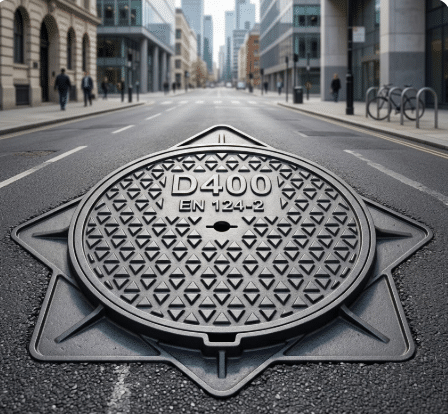
The modern urban landscape is a marvel of invisible engineering, where the seamless operation of a city depends on the structural integrity of its subterranean access points. As vehicles grow heavier and traffic volumes increase, the technical specifications governing road components have shifted from simple material standards to complex performance benchmarks. At the center of this transformation is the D400 load class, a designation that has become the de facto requirement for any access cover or gully grating intended for use in the main carriageways of city roads. For civil engineers, municipal planners, and infrastructure contractors, the term “D400” represents more than just a weight capacity; it is a comprehensive promise of safety, durability, and acoustic stability in high-traffic environments. Understanding the nuances of this classification requires an examination of the BS EN 124 standard, the physics of dynamic loading, and the material science that prevents infrastructure failure under the relentless stress of 21st-century mobility.
The transition from historical local standards to the harmonized European framework provided by BS EN 124 has allowed for a standardized language across infrastructure projects, ensuring that components manufactured in different regions meet the same rigorous safety protocols. While many stakeholders incorrectly assume that a D400 rating simply means a cover can withstand 40 tonnes of pressure, the technical reality is far more sophisticated. It encompasses specific test platen sizes, controlled application rates, and strict limits on permanent deformation known as “permanent set”. Furthermore, as cities prioritize liveability, the D400 class has evolved to include design features for noise reduction and skid resistance, moving the manhole cover from a passive slab of iron to an active participant in urban safety and comfort. This report serves as an exhaustive guide to the D400 load class, detailing its regulatory origins, technical parameters, and the critical role it plays in the longevity of urban road networks.
The Regulatory Genesis: From BS 497 to BS EN 124:2015
The history of manhole cover standardization in the United Kingdom and Europe is marked by a shift toward increasing specialization and material diversity. Before the 1990s, the UK relied on BS 497, a standard that focused primarily on traditional cast iron castings for drainage and utility access. However, as the range of materials used in infrastructure expanded to include ductile iron, steel, and composites, the need for a more versatile standard became apparent. This led to the introduction of BS EN 124 in 1994, which standardized load classes across European countries and categorized installation areas into six distinct groups. The most recent update, BS EN 124:2015, further refined this approach by splitting the standard into six parts based on the material used: Part 1 for general principles, Part 2 for cast iron, Part 3 for steel and aluminum, Part 4 for reinforced concrete, Part 5 for composite materials, and Part 6 for plastics like polypropylene.
This modular structure ensures that regardless of the material choice, a product must demonstrate consistent performance under load to achieve a D400 rating. Part 1 defines the overarching design requirements, such as clear opening dimensions and the “stepping size” of the frame, while the material-specific parts address the unique failure mechanisms of iron versus composites. For instance, Part 2 mandates specific metallurgical properties for ductile iron, such as nodularity, to ensure impact resistance, while Part 5 focuses on aging and chemical resistance for fiberglass-reinforced polymers. By unifying these requirements under the D400 banner, the standard allows procurement officers to compare performance across different material technologies, facilitating the adoption of innovative, lightweight solutions in city centers where manual handling and theft deterrence are major concerns.
The Hierarchy of Loading Groups
To effectively manage the risks associated with road traffic, BS EN 124 uses a grouping system to match load classes with specific environments. D400 is exclusively tied to Group 4, which represents the standard for carriageways where all types of road vehicles have access. Selecting the wrong group can have disastrous consequences; a C250 cover, intended for kerbside channels, lacks the structural mass and non-rock features required for a high-speed traffic lane. The table below outlines the relationship between the loading environment and the minimum required class, illustrating why D400 is the indispensable baseline for the majority of urban road infrastructure.
| BS EN 124 Group | Application Area Description | Minimum Load Class | Test Load (kN) |
| Group 1 | Areas used solely by pedestrians and pedal cyclists | A15 | $15 kN$ |
| Group 2 | Footways and pedestrian precincts with occasional light vehicle access | B125 | $125 kN$ |
| Group 3 | Kerbside channels and gully tops extending $500 mm$ into the road | C250 | $250 kN$ |
| Group 4 | Carriageways, hard shoulders, and parking areas for all vehicles | D400 | $400 kN$ |
| Group 5 | High wheel load areas like loading bays, docks, and transport terminals | E600 | $600 kN$ |
| Group 6 | Areas with extreme wheel loads, such as aircraft pavements | F900 | $900 kN$ |
This classification system acts as a risk management tool for local authorities. Increasingly, public sector contracts and utility company specifications require strict adherence to BS EN 124, and any deviation can void insurance coverage or lead to legal liability in the event of an accident. The D400 class is the most frequently specified category in municipal projects because it offers an optimal balance between material cost and the resilience required for continuous bus and truck traffic.
Technical Anatomy: Decoding the $400 kN$ Test
The designation “D400” primarily refers to the requirement that the cover and frame assembly withstand a static test load of $400 kN$ (approximately 40 metric tons). However, the testing procedure is far more rigorous than a simple crushing test. Under laboratory conditions, the assembly is placed on a rigid test bed, and a load is applied using a standardized steel block, typically measuring $250 mm \times 50 mm$ or a circular equivalent, depending on the clear opening size. A $10 mm$ rubber pad is placed between the block and the cover to simulate the contact pressure of a pneumatic tire, ensuring that the stress is distributed in a manner that reflects real-world vehicular interaction.
The load application rate is precisely controlled, typically between $1 kN/s$ and $5 kN/s$, to prevent shock loading that could skew the results. Once the $400 kN$ threshold is reached, the load must be held for a specific duration—often 30 seconds—while the cover is monitored for any signs of cracking, fracture, or delamination. For ductile iron covers, which are common in D400 applications, the material’s elasticity allows it to deflect under pressure and return to its original state. If a cover fails to reach the required load or exhibits structural failure during the hold period, it is deemed non-compliant and cannot be installed on public roads.
Permanent Set: The Measure of Resilience
Beyond the ultimate load-bearing capacity, the most critical performance metric for a D400 cover is the “permanent set.” This test measures the residual deformation of a cover after it has been loaded and unloaded multiple times. Specifically, the cover is subjected to $2/3$ of its test load (approximately $267 kN$ for D400) for five repetitive cycles. Before the first cycle, an initial measurement is taken at the geometric center of the cover. After the fifth cycle, the final deflection is recorded.
The permanent set is calculated as the difference between these two readings. For a D400 cover to be certified, this residual deformation must be strictly limited. In heavy-duty applications, the permissible permanent set is often defined as a fraction of the clear opening diameter, such as $\leq 1/300$ of the stepping size. For a standard $450 mm$ cover, this means the permanent set should not exceed $1.50 mm$. If a cover passes the $400 kN$ load test but has a permanent set of $3 mm$, it would fail certification. This is because a warped cover creates an uneven road surface, leading to vehicle rattling, increased dynamic impact loads, and the collection of water, which accelerates asphalt degradation around the frame.
Material Science in the Carriageway: Iron vs. Composites
The performance of a D400 installation is fundamentally determined by the material properties of the casting or molded component. For decades, ductile iron has been the undisputed champion of the city road, prized for its exceptional tensile strength and flexibility. Unlike traditional gray cast iron, which can fracture like glass under impact, ductile iron contains nodular graphite that allows it to absorb high-energy pulses from heavy axles without brittle failure. This material, often specified as GJS 500-7 or GJS 600-9, provides a critical safety margin in urban environments where covers are subject to unintended loads from over-laden delivery trucks or construction equipment.
In recent years, however, a “composite revolution” has begun to challenge the dominance of iron in the D400 space. Advanced Fiber-Reinforced Polymers (FRP) and Sheet Molding Compounds (SMC) are being deployed in cities like London, Berlin, and Singapore to solve challenges that iron cannot address. Composite D400 covers are up to 70% lighter than their iron counterparts, which significantly reduces the risk of workplace injuries during installation and maintenance. Furthermore, because composite materials have zero scrap value, they are inherently theft-proof, protecting critical subterranean utilities from unauthorized access and preventing the lethal hazard of open pits in city streets.
Durability and Fatigue Comparison
When evaluating D400 materials, engineers must consider long-term fatigue resistance—the ability of a cover to withstand millions of loading cycles over its service life. Ductile iron has a proven legacy of fatigue performance, often lasting 30 to 50 years if protected from corrosion with bituminous or epoxy coatings. Its nodular structure acts as an internal crack-stopper, ensuring that microscopic flaws do not propagate into structural failures under repetitive stress.
Composites offer a different set of advantages. While high-performance FRP covers can meet the $400 kN$ static load requirement, their behavior under dynamic traffic cycles is influenced by resin quality and fiber density. Composites are immune to corrosion from de-icing salts and moisture, making them ideal for coastal cities or regions with harsh winters where iron covers might suffer from “corrosion fatigue”. The following table summarizes the trade-offs between these two dominant D400 material technologies.
| Performance Feature | Ductile Iron (DI) | Composite (FRP/SMC) |
| Weight Comparison | Heavy ($100\%$) | Ultra-Light ($30\% – 40\%$) |
| Tensile Strength | Superior ($>420 MPa$) | High (Reinforcement dependent) |
| Corrosion Risk | Moderate (Needs coating) | Excellent (Natural resistance) |
| Theft Deterrence | Low (High scrap value) | High (Zero resale value) |
| Electrical Safety | Conductive | Non-conductive |
| Service Life | 30–50 Years | 20–30 Years (Resin dependent) |
For most high-speed arterial roads, ductile iron remains the preferred choice due to its mass, which contributes to stability within the frame. However, for urban sidewalks, commercial parking lots, and residential streets where utility access is frequent, composites offer a compelling combination of safety, ergonomics, and lower whole-life costs through reduced maintenance.
Strategic Highway Requirements: The UK CD 534 Mandate
In the United Kingdom, the National Highways authority has recognized that the baseline D400 requirements of BS EN 124 are sometimes insufficient for the extreme demands of the strategic road network. This led to the development of CD 534 (formerly HA 104/09), a set of enhanced requirements for manhole covers and gully grates installed on motorways and all-purpose trunk roads. One of the most significant changes in the v0.2.0 update is the “AADT 1500” rule, which introduced a cumulative loading threshold for product selection.
Under this regulation, if a road carries an Annual Average Daily Traffic (AADT) of more than 1,500 light goods vehicles in each direction, a D400 rated cover is considered insufficient, and a higher-rated E600 cover must be installed instead. This requirement accounts for the fact that even if an individual vehicle does not exceed the D400 weight limit, the sheer frequency of loading cycles can lead to accelerated bedding failure and material fatigue. Most major A-roads and motorways in the UK fall into this category, effectively making E600 the standard for the strategic network while D400 remains the benchmark for municipal and council-maintained roads.
Managing Frame Bedding Pressure
Another critical contribution of CD 534 is the standardization of nominal bearing pressure to ensure the integrity of the installation foundation. Load transfer from the frame to the underlying bedding mortar is a primary factor in the lifetime of an access assembly. To prevent the mortar from being crushed under heavy traffic, CD 534 mandates a minimum frame flange area and sets the nominal bearing pressure at $\leq 2.1 N/mm^2$.
| Parameter | Requirement for D400 (Standard) | Requirement for CD 534 Highway Use |
| Nominal Bearing Pressure | Not explicitly set in Part 1 | $\leq 2.1 N/mm^2$ |
| Minimum Flange Area | Product dependent | $\geq 190,000 mm^2$ (for $600 \times 600$) |
| Frame Depth | $\geq 100 mm$ | $\geq 150 mm$ (for motorways) |
| Frame Mass | Manufacturer specific | Lower limit specified for stiffness |
By calculating the nominal bearing pressure—dividing the $400 kN$ test load by the flange area—engineers can ensure that the bedding material is not overstressed. This engineering rigor addresses the findings of a Water Research Centre (WRc) study, which concluded that at least 30% of manhole cover failures are caused by the disintegration of the bedding mortar rather than the cover itself. Installations that meet the CD 534 specifications provide a robust, long-lasting interface between the metal components and the road structure, drastically reducing the need for disruptive and costly road repairs.
The Silent Guardian: Engineering for Noise Reduction
In the pursuit of “quiet urban zones,” the acoustic performance of manhole covers has become a top priority for city planners. A traditional D400 cover that rattles or clangs every time a car passes is more than a nuisance; it is a source of urban stress that affects the quality of life for residents. Modern D400 designs address this through three primary mechanisms: precision machining, dampening gaskets, and geometric stability.
Precision engineering ensures that the gap between the cover and the frame is minimized, typically to a tolerance of $\leq 1 mm$. This tight fit prevents “metal-on-metal” impacts during wheel passage. Furthermore, many D400 assemblies now incorporate continuous elastomeric gaskets or polyurethane damping pads. In a landmark case study in Singapore, the Land Transport Authority replaced standard covers with hybrid units featuring polyurethane pads and a triple-seal system, resulting in a 60% reduction in intersection noise levels. These gaskets not only absorb vibration but also provide a watertight and odor-resistant seal, which is essential for manholes located near residential windows or high-end commercial districts.
The Non-Rock Mechanism: Double Triangular Design
One of the most effective mechanical solutions for noise and stability is the “three-point suspension” or double triangular design. This configuration splits a square cover into two triangular halves that are loosely bolted together. Based on the geometric principle that a three-legged stool never wobbles, a triangular plate supported at its corners is inherently stable even if the frame is slightly misaligned during installation.
For standard circular or square covers, the center of gravity of a passing load can move outside the support points, causing the lid to tilt and then “slap” back into the frame—a phenomenon known as rocking. The double triangular design ensures that the load is always distributed through three distinct support points, maintaining a silent and rock-free seat even under high-speed traffic. This design is so effective that it has become the standard for “Highway” range D400 covers, where non-rock stability is a mandatory requirement for safety-critical zones.
Safety Thresholds: Skid Resistance and PSRV
Road safety for D400 manhole covers involves more than just holding weight; it also requires the prevention of skidding, particularly for cyclists and motorcyclists in wet conditions. The anti-slip properties of a cover are measured by its Polished Skid Resistance Value (PSRV) or Pendulum Test Value (PTV). International standards like BS EN 124 mandate that covers in vehicular carriageways possess a surface pattern that maintains friction even after years of traffic polishing.
Modern D400 designs utilize complex, multi-directional tread patterns that are often computer-optimized to channel water away from the contact patch, mimicking the technology found in automotive tires. In the UK, CD 534 sets clear thresholds for skid resistance: low-risk areas require a minimum of 45+ PSRV, while high-risk areas, such as braking zones or sharp corners, require a minimum of 60+ PSRV. Top-tier products like the Wrekin Highway range are independently tested to achieve 70+ PSRV, ensuring that the cover provides as much grip as the surrounding high-friction road surface.
Micro-Roughness and Long-Term Safety
The longevity of a cover’s skid resistance is determined by two factors: macro-roughness and micro-roughness. Macro-roughness is the visible pattern (chequers, triangles, or bars) that provides bulk water drainage and prevents hydroplaning. Micro-roughness is the fine-scale texture of the material itself that provides a physical grip for tires and shoes.
Over decades of use, heavy commercial traffic can “polish” a metal cover, stripping away its micro-roughness even if the larger pattern remains visible. When a cover’s skid resistance falls below the safety threshold, it becomes a “silent hazard” on rainy days. Proactive municipal maintenance now involves periodic friction testing using portable pendulum testers. If a cover fails, it must be either replaced or treated with an aggressive abrasive surface coating or an epoxy aggregate treatment to restore its anti-slip properties. High-quality D400 covers made from ductile iron are particularly favored because the material can be cast with sharper, more resilient textures that resist the polishing effect longer than softer materials.
Critical Installation Protocols: The 50 N/mm2 Rule
The most advanced D400 manhole cover will inevitably fail if it is improperly installed. The stability of the entire system depends on the interface between the metal frame and the concrete or asphalt road structure. A leading cause of premature failure is the use of low-strength bedding materials or inadequate curing times. Industry best practices recommend using a high-performance cement mortar with a characteristic compressive strength ($Rck$) of at least $50 N/mm^2$.
This high strength is necessary to resist the lateral shear forces generated by vehicles braking or accelerating over the cover. If the mortar is too weak, these forces will cause micro-cracks that allow water to enter the foundation. In cold climates, this leads to freeze-thaw expansion, which rapidly destroys the bedding and causes the manhole to sink. The installation must follow a meticulous protocol, including ensuring a bedding thickness of $15 mm$ to $50 mm$ and ensuring the mortar is “hand-packed” or “flowed” to completely encapsulate the frame flange.
Anchoring and Leveling for Dynamic Stability
For D400 installations in busy carriageways, mechanical anchoring provides an additional layer of security. Engineers recommend anchoring the frame directly to the concrete chamber wall using stainless steel fastener plugs positioned in specific circular slots in the frame. This prevents the frame from shifting under the vibration of heavy bus traffic.
| Installation Milestone | Technical Requirement | Strategic Benefit |
| Mortar Strength | $\geq 50 N/mm^2$ | Resists crushing and lateral shear |
| Bedding Thickness | $15 mm – 50 mm$ | Prevents cracking from thinness or settling |
| Leveling Tolerance | $\pm 2 mm$ | Eliminates impact loads from “bumps” |
| Curing Time | $24 – 72$ Hours | Ensures material reaches design strength |
| Anchoring | Stainless Fastener Plugs | Prevents frame movement in high-traffic |
Final leveling is perhaps the most visible aspect of a quality installation. The cover must sit perfectly flush with the finished road surface. A protrusion of even $5 mm$ can act as a “road bump,” generating dynamic amplification factors that increase the effective load of a passing wheel by up to 30%. Using laser-guided leveling tools or “ScrewLift” mechanisms built into the frame ensures a smooth transition for vehicles, protecting the suspension of the car and the structural integrity of the manhole.
The Future of the Streetscape: Smart D400 Infrastructure
As cities transition to “Smart City” models, the humble D400 manhole cover is being integrated into the Internet of Things (IoT). Modern covers are now being manufactured with built-in provisions for communications equipment, such as antennas, sensors, and RFID tags. This allows utility companies to monitor wastewater flow, detect unauthorized access, or track maintenance schedules in real-time without the need for manual inspections.
Composite D400 covers are particularly well-suited for this future, as their non-metallic composition is “RF transparent,” allowing radio signals to pass through the cover to surface-level receivers. For iron covers, manufacturers have developed specialized “ID bolts” or sensor mounts that sit flush with the surface. By turning the D400 cover into a smart asset, municipalities can shift from reactive repairs to predictive maintenance, identifying a loosening frame or a cracked bedding layer before it causes a traffic accident. This holistic approach—combining raw structural strength with digital intelligence—ensures that the D400 load class will remain the cornerstone of urban resilience for decades to come.
Conclusion
The D400 load class is a sophisticated engineering standard that defines the safety and functionality of the modern urban carriageway. Far from being a simple weight rating, it is a comprehensive system that mandates static strength, dynamic resilience, and acoustic performance through the BS EN 124 framework. Whether through the metallurgical innovation of ductile iron or the ergonomic advantages of advanced composites, a D400 rating ensures that infrastructure can withstand the millions of loading cycles imposed by buses, trucks, and commuters.
However, the success of a D400 installation relies on the synergy between the product and its surrounding environment. The UK’s CD 534 v0.2.0 has shown that for the busiest roads, a simple D400 rating must be supplemented by higher flange areas and superior bedding mortars to prevent the 30% failure rate associated with structural bedding degradation. By prioritizing precision installation, high-friction surfaces, and noise-reducing designs, city planners can create a streetscape that is not only robust enough to handle heavy traffic but also quiet and safe for all users. The D400 class remains the essential benchmark for any project aiming to build a more resilient, livable, and efficient urban future.
Frequently Asked Questions (FAQ)
1. What does the “400” in D400 load class specifically represent?
The “400” refers to the test load of $400 kN$ (kilonewtons) that the manhole cover and frame assembly must withstand in a laboratory setting without structural failure or cracking. While this is approximately equivalent to 40 metric tons, the rating is actually a performance benchmark that includes a “permanent set” requirement. This means that after being loaded to $2/3$ of the test load ($267 kN$) for five cycles, the cover must not suffer any residual deformation greater than $1/300$ of its clear opening diameter. This ensures the material remains elastic and the road surface stays level.
2. Is a D400 manhole cover always suitable for highway use?
In most urban environments, D400 is the standard for roads and parking areas. however, in jurisdictions like the UK, the National Highways authority requires an upgrade under specific conditions. According to the CD 534 v0.2.0 standard, if a road carries more than 1,500 light goods vehicles (AADT) in each direction, an E600 rated cover must be used instead of D400. This is because the high frequency of loading cycles on busy trunk roads can cause cumulative fatigue that exceeds the standard D400 design life, leading to premature failure of the bedding and frame.
3. Why is ductile iron used more often than traditional cast iron for D400 covers?
Traditional “gray” cast iron is strong but brittle, meaning it lacks the flexibility to absorb sudden impacts and can shatter under extreme stress. Ductile iron (nodular cast iron) is treated with magnesium during the casting process, which causes the carbon to form spherical nodules rather than flakes. This metallurgical breakthrough gives the material high tensile strength and elasticity (ductility), allowing it to bend and return to its shape rather than breaking. This provides a vital safety margin for heavy traffic areas where “dynamic” loads can exceed static ratings.
4. Can composite manhole covers meet the D400 load requirement?
Yes, modern composite materials engineered from fiberglass, thermosetting resins, and polymer compounds are fully capable of achieving a D400 rating under BS EN 124-5. These covers are increasingly popular in city centers because they are up to 70% lighter than iron, making them safer for a single worker to handle without heavy equipment. Additionally, composites are immune to corrosion from road salts and have no scrap resale value, which virtually eliminates the problem of manhole cover theft that plagues many urban areas.
5. How does the bedding mortar affect the performance of a D400 cover?
The bedding mortar is the unsung hero of a D400 installation. Even the strongest cover will fail if the mortar beneath the frame is weak. Professional standards require a mortar with a compressive strength of at least $50 N/mm^2$ to withstand the lateral forces of braking and accelerating vehicles. If the mortar is too weak or too thin (less than $15 mm$), it will crack and disintegrate, causing the manhole to sink and become a dangerous hazard. At least 30% of all manhole failures are attributed to bedding issues rather than a failure of the cover itself.