Manhole covers are an essential yet often overlooked component of modern urban infrastructure. Found on roads, sidewalks, industrial zones, residential neighborhoods, and transportation hubs, they provide secure access to underground utilities such as sewer systems, drainage networks, electrical cables, telecommunications lines, and water pipelines. As cities grow denser and infrastructure demands increase, the role of manhole covers has evolved from simple access points to highly engineered safety and performance products.
Understanding the types of manhole covers used in modern cities is critical for urban planners, municipal engineers, contractors, and procurement professionals. Different environments require different materials, load capacities, designs, and safety features. Choosing the wrong type can lead to traffic hazards, increased maintenance costs, noise issues, or premature failure.
Cast Iron Manhole Covers
Cast iron manhole covers have been used for decades and remain one of the most widely deployed solutions in urban environments. Traditional gray cast iron offers good compressive strength and wear resistance, making it suitable for low- to medium-traffic areas such as sidewalks, residential streets, and pedestrian zones. Their long history in municipal infrastructure has resulted in standardized shapes, sizes, and load classifications.
However, cast iron manhole covers also have limitations. Compared to modern materials, they are relatively brittle and may crack under repeated dynamic loads or impact stress. They are also vulnerable to corrosion in aggressive environments, especially where road salts or coastal conditions are present. Despite these drawbacks, cast iron covers continue to be used in many cities due to their affordability, ease of manufacturing, and familiarity among maintenance teams.
Ductile Iron Manhole Covers
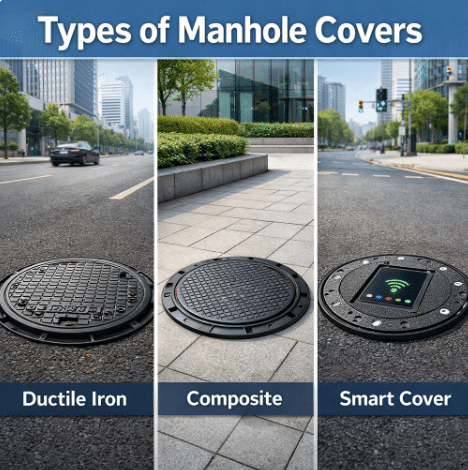
Ductile iron manhole covers represent a significant advancement over traditional cast iron. By modifying the graphite structure within the iron, ductile iron achieves superior tensile strength, impact resistance, and fatigue performance. These properties make it the preferred choice for high-traffic urban roads, highways, industrial areas, and airport pavements.
Modern cities increasingly rely on ductile iron manhole covers because they comply with international standards such as EN 124 and ASTM specifications. Their high load-bearing capacity allows them to withstand heavy vehicle traffic without deformation or failure. Additionally, ductile iron offers improved durability and longer service life, reducing long-term maintenance and replacement costs. For municipalities focused on safety and lifecycle value, ductile iron covers are often considered the benchmark solution.
Composite Manhole Covers
Composite manhole covers are gaining rapid popularity in modern cities, particularly in residential, commercial, and environmentally sensitive areas. Made from reinforced polymer materials such as fiberglass, resin, or advanced composites, these covers are lightweight, corrosion-resistant, and non-conductive. Their low weight simplifies installation and maintenance while improving worker safety.
One of the key advantages of composite manhole covers is their resistance to theft, as they have no scrap metal value. This makes them especially attractive in regions where metal theft is a concern. Additionally, composite covers offer excellent resistance to chemicals, moisture, and extreme temperatures. While they may not always match ductile iron in ultra-heavy load applications, advancements in material engineering are steadily expanding their use in modern urban infrastructure.
Concrete Manhole Covers
Concrete manhole covers are commonly used in utility corridors, green spaces, and low-traffic areas within cities. Often reinforced with steel bars or fibers, concrete covers provide adequate strength at a relatively low cost. Their neutral appearance also allows them to blend seamlessly into landscaped or pedestrian environments.
Despite their cost-effectiveness, concrete manhole covers have limitations in durability and handling. They are heavier than composite alternatives and may be prone to cracking under repeated loads or freeze-thaw cycles. As a result, many modern cities are gradually replacing concrete covers in critical traffic zones with ductile iron or composite solutions to improve safety and longevity.
Steel Manhole Covers
Steel manhole covers are typically used in specialized urban applications where high strength and thin profiles are required. These covers are often fabricated rather than cast, allowing for custom shapes, sizes, and integrated locking mechanisms. Steel covers are commonly found in industrial plants, ports, and infrastructure facilities.
However, steel manhole covers require effective corrosion protection, such as galvanization or coatings, to ensure long-term performance. Without proper treatment, they may degrade faster than ductile iron alternatives. As a result, steel covers are usually selected for specific technical requirements rather than general municipal use.
Smart and Sensor-Integrated Manhole Covers
As cities adopt smart infrastructure strategies, sensor-integrated manhole covers are emerging as an innovative solution. These advanced covers incorporate sensors that monitor parameters such as water level, temperature, vibration, or unauthorized opening. Data collected is transmitted in real time to municipal management systems.
Smart manhole covers enhance urban safety by enabling early detection of flooding, structural issues, or tampering. They also improve operational efficiency by supporting predictive maintenance and reducing emergency response costs. While currently more expensive than conventional covers, their long-term value is increasingly recognized in smart city projects worldwide.
Anti-Theft and Locking Manhole Covers
Theft and unauthorized access are serious challenges in many urban areas. Anti-theft manhole covers address these issues through locking systems, unique designs, or non-metal materials. Locking mechanisms prevent accidental displacement and unauthorized opening, improving public safety.
Modern cities often specify anti-theft designs for installations in public roads, utility corridors, and critical infrastructure zones. These covers not only protect underground assets but also reduce the frequency of replacements, contributing to better lifecycle cost management.
Conclusion
The types of manhole covers used in modern cities reflect the increasing complexity of urban infrastructure and the growing emphasis on safety, efficiency, and sustainability. From traditional cast iron to advanced composite and smart manhole covers, each type serves specific functional and environmental requirements.
Selecting the appropriate manhole cover involves careful consideration of load capacity, material performance, installation environment, and long-term maintenance costs. As cities continue to evolve, the demand for durable, intelligent, and cost-effective manhole cover solutions will continue to rise, making informed selection more important than ever for urban stakeholders.
Frequently Asked Questions (FAQ)
1. What is the most common manhole cover used in modern cities?
Ductile iron manhole covers are the most widely used due to their strength and durability.
2. Are composite manhole covers suitable for urban roads?
Yes, especially for light to medium traffic areas, with newer composites supporting higher loads.
3. Why are smart manhole covers important?
They improve safety and efficiency through real-time monitoring and predictive maintenance.
4. How do anti-theft manhole covers work?
They use locking systems or non-metal materials to prevent theft and unauthorized access.
5. Which manhole cover type has the longest service life?
Ductile iron covers generally offer the longest lifespan under heavy urban traffic conditions.