Parking lots are high-traffic transitional spaces that bridge pedestrian zones and roadways, serving commercial buildings, shopping centers, hospitals, industrial parks, and residential complexes. Within these environments, parking lot manhole covers play a critical but often underestimated role in ensuring safety, structural integrity, and long-term infrastructure performance. Unlike standard sidewalk applications, parking lots experience mixed loads from passenger vehicles, delivery vans, and occasionally heavy trucks, making design and load considerations especially important.
Poorly designed or incorrectly specified manhole covers can lead to surface deformation, noise issues, premature failure, and serious safety hazards. This article provides a comprehensive overview of parking lot manhole cover design and load considerations, helping engineers, contractors, and procurement professionals make informed decisions that align with international standards and real-world operating conditions.
Why Parking Lot Applications Require Specialized Manhole Covers
Parking lots represent a unique category between light pedestrian areas and full-scale roadways. Parking lot manhole covers must accommodate frequent low-speed vehicle loads, repeated braking forces, and occasional point loads from heavier service vehicles. These dynamic stresses differ significantly from static pedestrian loads or continuous highway traffic.
Additionally, parking areas are often subject to temperature fluctuations, water exposure, de-icing chemicals, and surface settlement. Manhole covers installed in these environments must maintain level alignment with pavement surfaces to prevent trip hazards and vehicle damage. Therefore, selecting covers specifically designed for parking lot conditions is essential for durability, safety, and reduced lifecycle costs.
Load Classification Standards for Parking Lot Manhole Covers
One of the most important design considerations is load-bearing capacity. International standards such as EN 124 classify manhole covers based on their load resistance. For parking lot applications, Class B125 or C250 is commonly recommended, depending on vehicle frequency and weight.
B125 covers are typically suitable for passenger vehicles and light commercial traffic, while C250 covers are preferred in parking areas that may occasionally support delivery trucks or emergency vehicles. Using an underspecified load class can result in cracking, deformation, or catastrophic failure, while overspecification may unnecessarily increase costs. Correct load classification ensures safety compliance and optimal performance.
Material Selection and Structural Design
Material choice directly impacts the performance of parking lot manhole covers. Ductile iron remains the most widely used material due to its high tensile strength, impact resistance, and fatigue durability. Compared to traditional cast iron, ductile iron offers superior load distribution and crack resistance under repeated vehicle stress.
In some applications, composite manhole covers are used for their corrosion resistance and lightweight handling advantages. However, material selection must always align with load requirements and environmental conditions. Structural design elements—such as reinforced frames, ribbed undersides, and precision-machined seating surfaces—further enhance load stability and extend service life.
Surface Design, Slip Resistance, and Noise Control
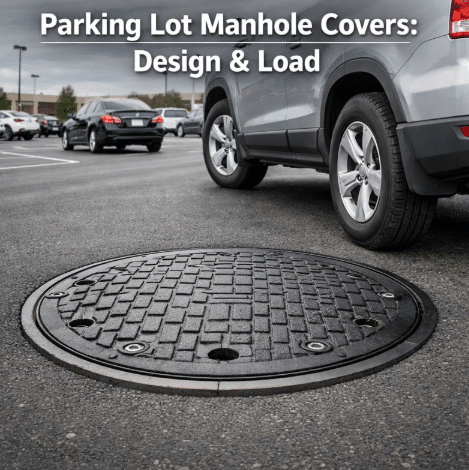
Surface texture is another critical aspect of parking lot manhole cover design. Covers must provide adequate slip resistance for both pedestrians and vehicles, especially in wet or oily conditions. Anti-slip patterns, such as raised textures or checker designs, help prevent skidding and accidents.
Noise reduction is equally important in parking lots near residential or commercial buildings. Poorly fitted covers can generate rattling or impact noise when vehicles pass over them. High-quality designs incorporate tight tolerances, gasket systems, or anti-noise inserts to minimize movement between the cover and frame, enhancing user comfort and perceived infrastructure quality.
Installation Quality and Pavement Integration
Even the best-designed parking lot manhole covers can fail if installed incorrectly. Proper installation requires precise leveling, stable bedding, and correct alignment with surrounding pavement. Differential settlement between the cover frame and asphalt or concrete surface can create uneven transitions that damage vehicles and accelerate pavement wear.
Best practices include using reinforced concrete collars, ensuring proper compaction, and allowing for thermal expansion. Coordination between civil engineers, contractors, and material suppliers during installation significantly reduces the risk of premature failure and maintenance issues.
Maintenance, Inspection, and Lifecycle Considerations
Parking lots are often subjected to constant use, making routine inspection essential. Parking lot manhole covers should be periodically checked for surface wear, frame movement, corrosion, and seal integrity. Preventive maintenance helps identify early signs of damage before they escalate into costly repairs or safety incidents.
From a lifecycle perspective, investing in higher-quality covers with proven load performance and corrosion protection often results in lower total ownership costs. Reduced replacement frequency, fewer liability risks, and improved user experience all contribute to long-term value.
Compliance, Safety, and E-E-A-T Considerations
From an E-E-A-T standpoint, reliable information, certified materials, and compliance with recognized standards are essential. Manufacturers and suppliers should provide test reports, load certifications, and quality management documentation such as ISO 9001. These elements reinforce trust, demonstrate expertise, and support regulatory compliance in public and private parking projects.
Conclusion
Parking lot manhole covers require thoughtful design and precise load consideration to perform safely and reliably in mixed-traffic environments. By selecting the appropriate load class, material, surface design, and installation method, project stakeholders can significantly enhance safety, durability, and long-term performance. In modern infrastructure planning, these components are not minor details but essential elements of resilient, user-friendly parking facilities.
Frequently Asked Questions (FAQ)
1. What load class is best for parking lot manhole covers?
Most parking lots require B125 or C250, depending on vehicle type and frequency.
2. Is ductile iron better than cast iron for parking lots?
Yes, ductile iron offers higher strength and better fatigue resistance.
3. Can composite manhole covers be used in parking areas?
They can be used in light-duty parking lots if certified for the required load class.
4. Why do some manhole covers make noise in parking lots?
Noise is usually caused by poor fit, lack of gaskets, or improper installation.
5. How often should parking lot manhole covers be inspected?
At least annually, or more frequently in high-traffic commercial areas.