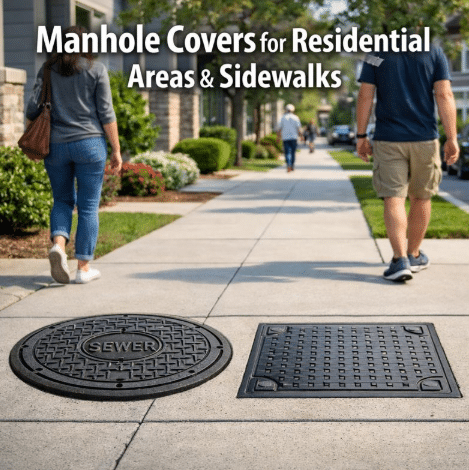
Manhole covers for residential areas and sidewalks are a critical yet often overlooked component of urban infrastructure. While they may appear simple at first glance, these covers play a vital role in public safety, accessibility, drainage performance, and long-term maintenance of underground utility systems. In residential neighborhoods and pedestrian sidewalks, the requirements for manhole covers differ significantly from those used in highways, industrial zones, or airports. Here, the focus shifts toward pedestrian safety, noise reduction, aesthetics, moderate load capacity, and cost-effective durability.
As cities continue to expand and prioritize walkable communities, the selection of appropriate manhole covers has become increasingly important. Poorly designed or incorrectly rated covers can lead to accidents, uneven pavement, excessive noise, and frequent maintenance issues.
Why Residential and Sidewalk Applications Require Specialized Manhole Covers
Residential streets and sidewalks present a unique operating environment. Unlike highways, these areas are primarily exposed to light vehicular traffic, bicycles, strollers, and heavy pedestrian flow. Manhole covers for residential areas and sidewalks must therefore balance sufficient load-bearing capacity with enhanced safety and comfort features.
In these settings, covers must sit flush with surrounding pavement to prevent tripping hazards. Surface texture and slip resistance are equally important, especially in wet or icy conditions. Noise control is another major consideration, as loose or poorly fitted covers can generate disruptive sounds when vehicles pass over them. Additionally, residential communities often require visually discreet or aesthetically compatible designs that blend with sidewalks, paving stones, or landscaped areas.
Load Classes Suitable for Residential Areas and Sidewalks
Load capacity is one of the most important technical specifications when selecting manhole covers. For residential streets and sidewalks, excessively high load ratings are unnecessary and cost-inefficient. Instead, international standards such as EN 124 define appropriate load classes for these environments.
Commonly used classes include:
- A15: Suitable for pedestrian zones, sidewalks, and bicycle paths
- B125: Designed for sidewalks, residential parking areas, and light vehicles
Using the correct load class ensures safety while avoiding over-engineering. Over-rated covers may increase project costs without providing additional benefits, while under-rated covers can crack, deform, or fail prematurely. Proper classification is therefore essential for long-term performance and regulatory compliance.
Materials Commonly Used for Residential Manhole Covers
The material selection for manhole covers for residential areas and sidewalks directly impacts durability, safety, maintenance, and lifecycle cost. Several materials are widely used, each with specific advantages.
Ductile iron remains one of the most popular choices due to its excellent strength-to-weight ratio and long service life. It offers reliable performance under moderate loads and is compatible with anti-slip surface treatments. Composite materials, such as fiberglass-reinforced polymers, are increasingly used for sidewalks due to their corrosion resistance, lightweight handling, and theft deterrence. Concrete covers are sometimes used in purely pedestrian zones, although they require precise installation to avoid cracking.
The choice of material should consider environmental exposure, local regulations, and maintenance capabilities.
Safety Features and Pedestrian Protection
Safety is the primary concern in residential and sidewalk applications. Manhole covers for residential areas and sidewalks must minimize risks to pedestrians, cyclists, children, and individuals with limited mobility. Anti-slip surface patterns are essential to prevent falls, particularly in rainy or snowy climates.
Flush installation is equally important. Covers that sit above or below pavement level can create dangerous trip points or interfere with wheelchairs and strollers. Many modern designs incorporate frame-and-cover systems with tight tolerances to ensure long-term alignment. Locking mechanisms may also be used in public areas to prevent unauthorized access and accidental displacement.
Noise Reduction and Residential Comfort
Noise pollution is a frequent complaint in residential areas. Loose or poorly fitted manhole covers can rattle when vehicles pass over them, causing persistent disturbances. High-quality manhole covers for residential areas and sidewalks are engineered with precision-machined frames, anti-movement gaskets, or elastomeric inserts to eliminate vibration and noise.
These design features significantly improve quality of life for residents and reduce maintenance calls for municipal authorities. Over time, investing in noise-reduced systems often proves more economical than repeatedly adjusting or replacing inferior products.
Aesthetic Integration with Urban Design
Modern urban planning increasingly emphasizes visual harmony. Manhole covers are no longer treated purely as functional components; they are expected to integrate seamlessly into sidewalks, plazas, and residential streetscapes. Some covers can be infilled with paving stones or concrete, making them nearly invisible.
This aesthetic approach is particularly valuable in historic districts, residential developments, and pedestrian-focused commercial areas. By selecting appropriately designed manhole covers for residential areas and sidewalks, municipalities and developers can maintain infrastructure access without compromising the visual appeal of public spaces.
Installation and Maintenance Considerations
Even the best manhole cover will fail if improperly installed. Correct bedding, frame alignment, and load distribution are essential for long-term stability. Installation should follow manufacturer guidelines and relevant standards to prevent settlement or rocking.
From a maintenance perspective, residential manhole covers should allow easy access for inspections while remaining secure during daily use. Materials resistant to corrosion and wear reduce the frequency of replacement and lower overall lifecycle costs, making them a practical choice for long-term urban planning.
Future Trends in Residential Manhole Cover Design
As smart cities evolve, manhole covers for residential areas and sidewalks are also adapting. Emerging trends include lightweight composite covers, embedded identification systems, and enhanced sustainability through recycled materials. Some municipalities are exploring sensor-integrated covers that monitor flooding or unauthorized access in real time.
These innovations reflect a broader shift toward safer, more efficient, and environmentally responsible infrastructure solutions that support growing urban populations.
Conclusion
Manhole covers for residential areas and sidewalks are essential components of safe, comfortable, and sustainable urban environments. Selecting the right load class, material, safety features, and design ensures long-term performance while protecting pedestrians and enhancing neighborhood quality.
By prioritizing proper standards, professional manufacturing, and thoughtful installation, municipalities and developers can significantly reduce maintenance costs, improve public safety, and support modern urban living. As infrastructure demands continue to evolve, well-designed residential manhole covers will remain a cornerstone of reliable underground utility systems.
Frequently Asked Questions (FAQ)
1. What load class is best for sidewalks?
A15 is typically sufficient for pedestrian-only sidewalks.
2. Are composite manhole covers safe for residential use?
Yes, when properly rated and certified, they offer excellent safety and durability.
3. How can noise from manhole covers be reduced?
By using precision-fitted frames, gaskets, and anti-movement designs.
4. Do residential manhole covers need locking systems?
In public areas, locking systems are recommended for safety and security.
5. How long do residential manhole covers last?
High-quality covers can last several decades with proper installation and maintenance.