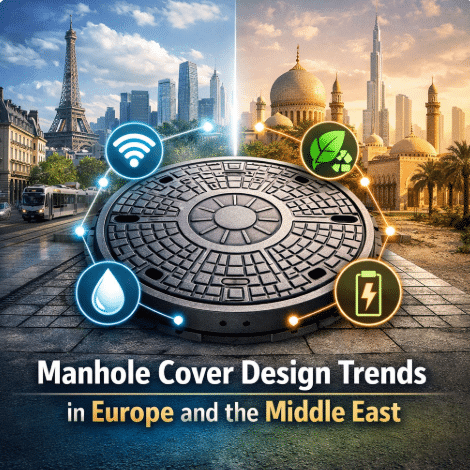
Manhole covers have long been uncelebrated yet essential components of urban infrastructure, providing safe, durable access to subsurface utilities such as sewer systems, telecommunications conduits, stormwater networks, and electrical vaults. However, in recent years, evolving urban needs have reshaped how engineers, municipalities, and manufacturers approach manhole cover design trends in Europe and the Middle East. Driven by factors such as sustainability, safety, aesthetics, smart city integration, and climate adaptation, manhole cover design is no longer a purely functional exercise. Instead, it encompasses cutting-edge engineering, materials science, digital monitoring, and cultural aesthetics.
Integration of Smart Technologies and IoT Monitoring
One of the most prominent trends in manhole cover design across Europe and the Middle East is the integration of smart technologies and Internet of Things (IoT) sensors. Traditional manhole covers were passive components, providing only physical coverage. Today’s designs increasingly embed sensors that monitor parameters including cover status (open/closed), unauthorized lifting, vibration, load stress, and even subsurface environmental conditions.
In smart cities like Amsterdam or Dubai, these technologies feed real-time data into centralized infrastructure management platforms. Transit authorities receive alerts for abnormal activity, enabling rapid response to incidents such as potential theft, accidental knocks by vehicles, or structural deterioration. For utilities, remote monitoring minimizes the need for physical inspections, improving safety and reducing operational costs. This trend reflects a broader shift toward data-driven infrastructure, where even the most mundane assets contribute to urban intelligence.
Enhanced Safety Features: Anti-Slip, Locking, and Load Response
Safety remains a central concern in both European and Middle Eastern roadway design, and manhole covers are no exception. Modern designs increasingly emphasize anti-slip surfaces, improved locking mechanisms, and enhanced load response to better protect pedestrians and vehicles.
In European cities where cobblestone streets and wet conditions are common, textured anti-slip surfaces are now standard. Coupled with precisely engineered frame interfaces, these features reduce slip risk for pedestrians and cyclists. Additionally, advanced locking systems—ranging from proprietary keys to tamper-resistant bolts and mechanical locks—help mitigate both theft and accidental displacement.
In the Middle East, where heavy traffic and high temperatures exert significant stress on road infrastructure, manhole covers are engineered with higher dynamic load classes and increased stability. These safety trends align with international standards (e.g., EN 124) while exceeding minimum requirements based on local applications.
Sustainable Materials and Circular Design Principles
Sustainability is a defining trend across global infrastructure projects, and manhole cover design is following suit. In both Europe and the Middle East, manufacturers are exploring eco-friendly materials and circular design principles that reduce environmental impact without compromising performance.
High-strength ductile iron remains popular due to its durability and recyclability. However, innovative composite materials—such as glass-reinforced polymers (GRP)—are gaining traction because of their lighter weight, corrosion resistance, and reduced carbon footprint. Recycled metal content and reclaimed materials are also increasingly used in European designs to meet aggressive sustainability targets.
This trend dovetails with broader municipal goals: lowering embodied carbon in infrastructure, extending product lifecycles, and designing for reuse and recyclability. Sustainable design not only improves environmental performance but can also reduce total lifecycle costs in long-term municipal budgets.
Aesthetic Integration and Urban Identity
Design trends in Europe and the Middle East increasingly emphasize aesthetic integration with the urban landscape. Rather than functional, blank plates, modern manhole covers are often tailored to reflect local identity, cultural motifs, or architectural themes.
In historic European cities such as Paris or Prague, manhole covers frequently feature decorative patterns inspired by local art, civic symbols, or cultural heritage. Municipal codes in some regions even encourage—or mandate—architecturally coordinated designs to maintain visual cohesion in historic districts.
In the Middle East, where modern luxury and cultural motifs blend uniquely, custom covers may incorporate calligraphic elements, geometric patterns, or references to national identity. Beyond aesthetics, these customized designs often enhance civic pride and reduce vandalism due to their visual integration.
Climate-Adaptive and Weather-Resilient Designs
Climate change and increasing urban stressors have amplified the need for climate-adaptive manhole covers. Both Europe and the Middle East contend with extremes—whether freezing, snow, and rain in northern and central Europe or desert heat and intense solar radiation in the Gulf.
European designers now integrate thermal expansion joints, corrosion-resistant coatings, and freeze-thaw tolerance into cover specifications to prevent cracking and fit loosening. In the Middle East, heat-resistant alloys, reflective surface coatings, and UV-stable polymers reduce heat absorption and material degradation.
This trend highlights the need for designs that are not only durable under static loads but resilient against environmental stressors, ensuring long service life and fewer maintenance interventions.
Standardization, Load Classification, and Modular Solutions
Both European and Middle Eastern infrastructure projects emphasize compliance with recognized standards such as EN 124 (Europe) and appropriate load classification systems that align with local traffic expectations. However, there is also a growing trend toward modular and standardized solutions that simplify procurement, installation, and future maintenance.
Modular designs allow utilities to replace just the cover or frame elements as needed, without disrupting surrounding infrastructure. Standardization reduces variability across city networks, simplifying inventory management and reducing long-term costs. For international contractors working across regions, modular standards help ensure interoperability and reduce project risk.
This dual emphasis on standardized load classification and modular flexibility illustrates how infrastructure design has matured from bespoke one-off solutions to scalable, maintainable systems.
Conclusion
The landscape of manhole cover design trends in Europe and the Middle East is evolving rapidly. What was once a purely functional piece of infrastructure has transformed into a high-performance, aesthetically integrative, and technologically enriched urban asset. From IoT integration and enhanced safety features to sustainable materials and climate-adaptive engineering, current design trends reflect broader imperatives in urban development.
For cities committed to modernization, resilience, and smart infrastructure management, understanding and adopting these trends can result in safer, more efficient, and more visually harmonious public spaces. As priorities shift and technology evolves, manhole cover design will continue to embody the intersection of functionality, sustainability, and urban identity.
Frequently Asked Questions (FAQ)
1. What drives the trend toward smart manhole covers?
Smart covers improve safety and efficiency by providing real-time monitoring and alerts for unauthorized activity or structural anomalies.
2. Are aesthetic considerations important in manhole cover design?
Yes, particularly in historic and high-profile urban areas where visual integration enhances civic identity.
3. Do composite materials perform as well as traditional metal covers?
Modern composites can match or exceed metal performance in corrosion resistance and weight, though application suitability must be evaluated per project.
4. How does climate affect manhole cover design?
Designs must account for thermal expansion, corrosion, freeze-thaw cycles, and UV exposure depending on regional climate conditions.
5. Why is modular design gaining popularity?
Modular designs simplify maintenance, reduce inventory complexity, and lower long-term lifecycle costs for municipal operators.