Why Manhole Covers Matter in Modern Drainage and Sewer Systems
In urban infrastructure, drainage and sewer systems operate largely out of sight, yet they are fundamental to public health, environmental protection, and road safety. Within these systems, manhole covers play a critical but often underestimated role. Understanding how manhole covers are used in drainage and sewer systems helps engineers, planners, and municipal authorities make informed decisions that improve durability, accessibility, and long-term cost efficiency.
Manhole covers are not simply surface closures; they are engineered access points that connect underground networks to the surface environment. Their design must balance structural strength, safety, hydraulic performance, and maintenance accessibility. As cities grow and infrastructure loads increase, the role of manhole covers in drainage and sewer systems becomes increasingly strategic, especially in flood-prone and high-traffic areas.
The Structural Role of Manhole Covers in Drainage and Sewer Systems
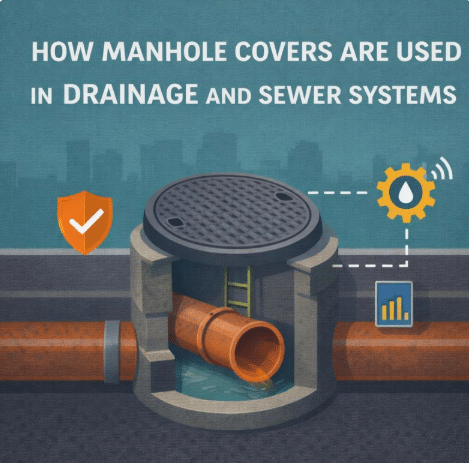
At a fundamental level, manhole covers provide a secure interface between underground drainage or sewer chambers and surface-level environments such as roads, sidewalks, and industrial zones. In drainage and sewer systems, these covers protect access shafts while transferring surface loads safely to surrounding structures.
Manhole covers must withstand dynamic loads from vehicles, vibrations, and environmental stresses without cracking or displacement. In sewer systems, they also help contain odors and prevent external debris from entering pipelines. Structurally, a properly selected manhole cover distributes pressure evenly across the supporting frame and surrounding concrete collar, reducing the risk of settlement or structural failure. This function is essential for maintaining both road integrity and underground network stability over long service cycles.
Access and Maintenance Functions in Drainage and Sewer Networks
One of the most important uses of manhole covers in drainage and sewer systems is providing controlled access for inspection, cleaning, and emergency intervention. Underground pipelines require periodic maintenance to remove sediment, blockages, or corrosion-related damage. Manhole covers allow technicians to enter or visually inspect these systems without surface excavation.
In sewer systems, access points are strategically located at pipeline intersections, changes in direction, and elevation shifts. This layout minimizes operational downtime and enables targeted maintenance. Well-designed manhole covers improve worker safety through anti-slip surfaces and secure locking mechanisms, while standardized dimensions ensure compatibility with maintenance equipment. Efficient access directly translates into reduced operational costs and faster response times during system failures.
Hydraulic Performance and Drainage Efficiency Considerations
In drainage systems, manhole covers influence hydraulic performance more than is commonly assumed. Covers used in stormwater networks often integrate with gratings or perforated designs that allow surface runoff to enter the drainage system efficiently. This is particularly important in urban areas with large impermeable surfaces.
Properly designed drainage manhole covers help manage peak rainfall events by reducing surface water accumulation and minimizing flood risk. In contrast, sewer system manhole covers are typically sealed to prevent stormwater inflow, which could overload treatment facilities. The distinction between drainage and sewer applications highlights how manhole cover design must align precisely with system function to maintain hydraulic balance and regulatory compliance.
Safety, Environmental Protection, and Urban Risk Control
Manhole covers in drainage and sewer systems serve as critical safety components for both pedestrians and vehicles. A displaced or structurally inadequate cover can cause serious accidents, making load-bearing capacity and secure seating essential design criteria. Anti-theft and locking designs further enhance public safety in high-risk urban areas.
From an environmental perspective, sealed sewer manhole covers prevent contaminants, debris, and unauthorized discharge from entering underground systems. This containment supports water quality protection and reduces the burden on wastewater treatment plants. In drainage systems, properly positioned covers help direct runoff into designed channels, minimizing erosion and surface pollution. Together, these functions position manhole covers as active risk-control elements rather than passive components.
Material Selection and Standards for Drainage and Sewer Applications
Material choice significantly affects how manhole covers perform in drainage and sewer systems. Ductile iron is widely used due to its high strength, fatigue resistance, and long service life under heavy loads. Composite materials are increasingly applied in pedestrian zones because of their corrosion resistance and lightweight handling advantages.
International standards such as EN 124 define load classes that guide selection based on installation environment. In sewer systems under roadways, higher load classes ensure durability under constant traffic stress. In drainage systems within green areas or sidewalks, lighter classes may be sufficient. Compliance with recognized standards not only ensures safety but also improves asset lifecycle management for municipalities and infrastructure owners.
Integration with Smart Infrastructure and Future Urban Systems
As cities adopt smart infrastructure concepts, manhole covers in drainage and sewer systems are evolving beyond purely mechanical components. Modern designs may incorporate sensors to monitor water levels, gas buildup, or structural movement in real time. These data-driven solutions enable predictive maintenance and early warning systems for flooding or blockages.
Integrated manhole cover systems support smarter urban water management by improving visibility into underground networks. This forward-looking approach reduces emergency repairs, optimizes maintenance schedules, and aligns with sustainability goals. As climate variability increases, intelligent manhole cover deployment will become an essential element of resilient drainage and sewer systems worldwide.
Conclusion: The Strategic Importance of Manhole Covers in Drainage and Sewer Systems
Understanding how manhole covers are used in drainage and sewer systems reveals their strategic importance in urban infrastructure. Beyond simple access points, they support structural stability, hydraulic efficiency, safety, environmental protection, and long-term cost control.
As infrastructure demands increase and cities pursue smarter, more sustainable solutions, manhole covers must be selected and designed with system-level thinking. Proper integration into drainage and sewer systems enhances resilience, reduces lifecycle costs, and safeguards public spaces. For engineers, planners, and decision-makers, manhole covers should be treated as essential infrastructure assets that directly influence system performance and urban quality of life.
Frequently Asked Questions (FAQ)
1. How are manhole covers different in drainage and sewer systems?
Drainage manhole covers often allow water inflow, while sewer manhole covers are typically sealed to prevent stormwater and debris intrusion.
2. Why is load-bearing capacity important for sewer manhole covers?
Sewer systems are frequently located under roads, requiring covers to withstand continuous traffic loads safely.
3. What materials are most suitable for drainage manhole covers?
Ductile iron and composite materials are commonly used, depending on load requirements and environmental conditions.
4. How do manhole covers support flood prevention?
Properly designed drainage manhole covers facilitate efficient runoff collection, reducing surface water accumulation during heavy rainfall.
5. Are smart manhole covers already in use?
Yes, sensor-enabled manhole covers are increasingly deployed to monitor water levels, gas buildup, and structural integrity in real time.