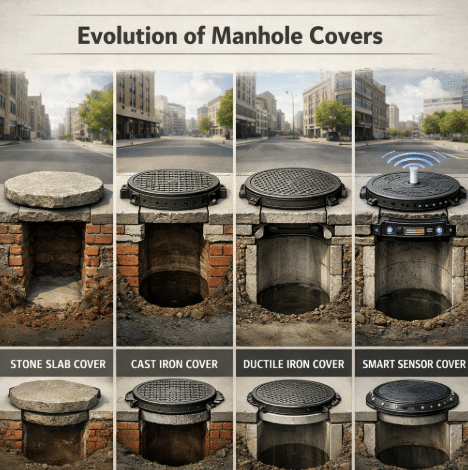
The history and evolution of manhole covers reflects the broader development of urban infrastructure, materials science, and public safety engineering. Although often overlooked, manhole covers are critical components of water supply systems, sewer networks, stormwater management, telecommunications, and utility distribution. Their design has evolved in response to increasing urbanization, heavier traffic loads, stricter safety regulations, and advances in manufacturing technologies.
Early Origins: Ancient Drainage and Access Systems
The origins of underground access structures can be traced to early civilizations that developed organized drainage and sewer systems. The ancient cities of the Indus Valley, particularly Mohenjo-Daro (circa 2500 BCE), featured covered drainage channels constructed from baked bricks and stone slabs. While these early covers were not standardized in shape or material, they served the fundamental purpose of protecting access points and preventing debris from entering the system.
Similarly, the Roman Empire implemented advanced sewer systems such as the Cloaca Maxima in Rome. Large stone slabs were placed over inspection and maintenance openings. These early covers were heavy and manually positioned, emphasizing durability over convenience. Although primitive compared to modern standards, these early solutions laid the groundwork for the concept of secure underground access and demonstrated the necessity of protective coverings in urban sanitation.
The Industrial Revolution: Standardization and Cast Iron Emergence
The history and evolution of manhole covers entered a transformative phase during the Industrial Revolution in the 18th and 19th centuries. Rapid urban expansion in Europe and North America demanded more organized sewage and utility networks. With the advancement of iron casting technologies, cast iron emerged as the preferred material for manhole covers.
Cast iron offered superior compressive strength, durability, and manufacturability compared to stone. It allowed for standardized shapes, primarily circular designs, which reduced production complexity and improved load distribution. The circular shape became dominant because it prevented covers from falling into the opening and distributed loads evenly across the frame.
During this period, municipalities began imprinting city names and foundry marks on covers. These markings served identification, branding, and quality assurance purposes. Standardization improved interchangeability and maintenance efficiency, setting the stage for modern regulatory frameworks.
20th Century Advancements: Engineering and Safety Integration
In the 20th century, urban infrastructure systems became more complex. Increased automobile traffic required stronger and more precisely engineered covers capable of withstanding dynamic loads. Traditional gray cast iron continued to be widely used, but limitations in impact resistance led to the development and adoption of ductile iron.
Ductile iron, also known as spheroidal graphite iron, provided improved tensile strength, flexibility, and fracture resistance. These characteristics significantly enhanced performance under heavy traffic conditions. Additionally, anti-slip surface textures were incorporated to improve pedestrian safety, particularly in wet conditions.
Noise reduction features, including rubber gaskets and precision-machined seating surfaces, were introduced to eliminate rattling caused by vehicle movement. These innovations marked a shift from purely structural considerations to integrated performance optimization, addressing safety, durability, and user experience simultaneously.
Regulatory Frameworks and Load Classifications
As engineering standards matured, formal testing and classification systems were introduced to ensure performance reliability. In Europe, the widely recognized standard EN 124 established load classes ranging from A15 (pedestrian areas) to F900 (airports and heavy industrial zones). These classifications specify load-bearing capacity, testing procedures, and installation requirements.
In the United States, organizations such as ASTM International developed material and performance standards that define quality benchmarks for cast iron and ductile iron components. These regulatory systems significantly improved global consistency, reduced infrastructure failures, and enhanced public safety.
The introduction of standardized testing represented a critical milestone in the history and evolution of manhole covers, shifting production from craft-based manufacturing to scientifically validated engineering processes.
Modern Materials: Composite and Polymer Innovations
Recent decades have introduced alternative materials, including composite and polymer-based manhole covers. Fiber-reinforced polymers (FRP) and glass-reinforced plastics (GRP) offer advantages such as corrosion resistance, lightweight handling, and non-conductivity. These features are particularly valuable in telecommunications, electrical, and chemically aggressive environments.
Composite covers also address theft concerns associated with metal scrap value. In many regions, cast iron covers have been stolen and resold, creating safety hazards. Lightweight composite alternatives reduce this risk while maintaining structural integrity when properly engineered.
However, metal covers remain dominant in high-load traffic zones due to proven long-term durability. The selection between materials depends on load class, environmental exposure, lifecycle cost, and regulatory compliance.
Smart Infrastructure and Digital Integration
The latest chapter in the history and evolution of manhole covers involves digital integration. Smart city initiatives are incorporating sensors into covers to monitor sewer levels, detect flooding, measure gas concentrations, and transmit real-time data. Embedded IoT technology allows municipalities to implement predictive maintenance strategies, reducing emergency repairs and improving resource allocation.
Some modern covers feature locking systems with tamper detection and GPS tracking. These enhancements address urban safety concerns while supporting asset management programs. The convergence of civil engineering and digital technology signals a new era where manhole covers become data collection nodes within intelligent infrastructure networks.
Design Evolution: Beyond Functionality
Over time, manhole covers have also become cultural artifacts. Many cities incorporate decorative patterns, historical emblems, or municipal branding into cover designs. In places such as Japan, elaborately designed covers depict local landmarks and symbols, transforming utilitarian objects into public art elements.
This aesthetic dimension illustrates how infrastructure components can contribute to civic identity while maintaining engineering performance. Despite stylistic variations, structural principles—load distribution, anti-slip design, and secure seating—remain central to their functionality.
Sustainability and Future Trends
Sustainability considerations are shaping the next generation of manhole cover development. Manufacturers increasingly emphasize recycled materials, energy-efficient casting processes, and longer service life. Lifecycle assessments are becoming standard practice in infrastructure planning.
Future innovations may include self-healing materials, advanced anti-corrosion coatings, and modular designs that simplify replacement. Additionally, climate resilience is a growing priority, particularly in flood-prone regions where sealed, watertight covers are essential.
The trajectory of development suggests continued integration of structural engineering, material science, and digital monitoring technologies, reinforcing the essential role of manhole covers in urban resilience strategies.
Conclusion
The history and evolution of manhole covers mirrors the progression of urban engineering itself. From ancient stone slabs to digitally enabled composite systems, each stage reflects advancements in materials, manufacturing, safety standards, and infrastructure management.
Today’s manhole covers are precision-engineered components that support transportation networks, protect underground utilities, and enhance public safety. As cities continue to grow and adopt smart infrastructure technologies, these seemingly simple elements will remain critical to sustainable and resilient urban systems. Understanding their historical development provides valuable context for future innovation and informed infrastructure investment.
Frequently Asked Questions (FAQ)
1. Why are most manhole covers round?
Round covers distribute loads evenly and cannot fall into the opening. The geometry ensures structural stability and safety.
2. When did cast iron become common for manhole covers?
Cast iron became widely used during the Industrial Revolution in the 18th and 19th centuries due to advances in casting technology.
3. What is the difference between cast iron and ductile iron?
Ductile iron has higher tensile strength and impact resistance due to its graphite structure, making it more durable under heavy loads.
4. Are composite manhole covers as strong as metal ones?
Composite covers can meet specific load classes but are typically used in lighter-duty or corrosion-sensitive environments.
5. How are manhole covers evolving today?
Modern covers incorporate smart sensors, anti-theft mechanisms, corrosion-resistant coatings, and sustainable materials.