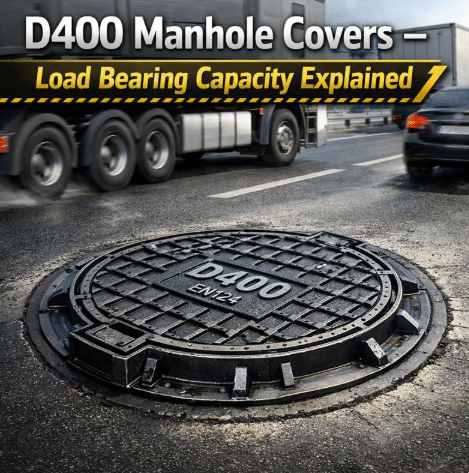
In modern urban infrastructure, manhole covers are far more than simple access points to underground utilities. They are structural components that must safely withstand constant mechanical stress from traffic, weather, and long-term environmental exposure. Among the various load classes defined by international standards, D400 manhole covers have become the industry benchmark for roadways, highways, and areas subjected to frequent vehicular traffic.
Understanding load bearing capacity is critical for engineers, municipal authorities, contractors, and procurement specialists. Incorrect selection of manhole cover load class can lead to premature failure, safety hazards, costly maintenance, and even legal liability. This guide explains the load bearing capacity of D400 manhole covers in detail—how it is defined, tested, and applied—helping buyers make informed, standards-compliant decisions for demanding infrastructure projects.
What Is Load Bearing Capacity in Manhole Covers?
Load bearing capacity refers to the maximum vertical force a manhole cover and its frame can withstand without permanent deformation or structural failure. In practical terms, it represents the cover’s ability to safely support vehicle loads passing over it during daily operation. This capacity is not an estimate; it is determined through standardized laboratory testing under controlled conditions.
For manhole covers, load bearing capacity is influenced by several factors, including material strength, casting quality, wall thickness, rib design, and the interface between the cover and frame. Importantly, the declared load class applies to the complete assembly—not just the cover alone. A well-designed cover paired with a poorly matched frame may fail to meet performance expectations, even if the material itself is strong.
Understanding the D400 Classification
The D400 classification originates from the European standard EN 124, which is widely recognized and adopted globally. Under this standard, D400 manhole covers are designed to withstand a test load of 400 kN (approximately 40 tons). This makes them suitable for installation in carriageways, hard shoulders, and roads accessible to heavy commercial vehicles.
D400 covers are commonly used in urban streets, logistics zones, industrial access roads, and highway service areas. They represent a balance between structural strength, weight, and cost, making them one of the most frequently specified load classes in municipal infrastructure projects. Compliance with EN 124 ensures that the product has passed rigorous testing for safety, durability, and performance consistency.
How Load Bearing Capacity Is Tested
Load testing for D400 manhole covers is conducted using standardized procedures defined in EN 124. During testing, the assembled cover and frame are placed on a rigid test bed and subjected to a gradually increasing vertical load. The test load is applied using a steel plate that simulates tire contact pressure, ensuring realistic stress distribution.
The assembly must withstand the full 400 kN test load without cracking, excessive deformation, or loss of structural integrity. In addition to static load tests, many manufacturers also conduct fatigue and impact tests to evaluate performance under repeated traffic cycles. These tests are essential because real-world conditions involve dynamic loads rather than a single static force.
Why D400 Is the Standard for Road Traffic Areas
D400 manhole covers are specifically engineered for environments where vehicular traffic is continuous and often heavy. Passenger cars, buses, delivery trucks, and occasional heavy-duty vehicles all exert repeated stress on road-installed infrastructure components. A lower load class may perform adequately at first but can deteriorate rapidly under these conditions.
By contrast, D400 covers provide long-term reliability, reduced risk of collapse, and improved road safety. Their robust design minimizes vertical movement, which helps prevent noise, surface damage, and wear to surrounding pavement. For municipalities and road authorities, D400 represents a cost-effective solution when considering lifecycle costs rather than initial purchase price alone.
Materials Commonly Used for D400 Manhole Covers
Most D400 manhole covers are manufactured from ductile iron, also known as nodular cast iron. This material offers superior tensile strength, impact resistance, and fatigue performance compared to traditional grey cast iron. The nodular graphite structure allows ductile iron to absorb stress without brittle fracture, making it ideal for load-bearing applications.
In some specialized cases, reinforced composite materials may be used for D400-rated covers, but only when they are specifically engineered and certified to meet the same load requirements. Regardless of material, strict quality control during manufacturing is essential to ensure consistency, dimensional accuracy, and compliance with declared load ratings.
Installation and Load Performance
Even the highest-quality D400 manhole cover can fail if it is improperly installed. Load bearing performance depends not only on the product itself but also on correct bedding, alignment, and integration with the surrounding road structure. Uneven support or incorrect leveling can lead to stress concentration, reducing the effective load capacity.
Proper installation ensures that loads are evenly distributed from the cover to the frame and into the supporting structure. For this reason, many standards and engineering guidelines emphasize installation procedures as a critical component of overall system performance. Training installers and following manufacturer recommendations significantly improves long-term reliability.
Safety, Compliance, and Risk Management
From a regulatory perspective, using certified D400 manhole covers reduces compliance risks and enhances public safety. Infrastructure failures caused by under-rated covers can result in vehicle damage, injuries, or fatalities, exposing project owners to legal and reputational consequences.
Selecting EN 124–compliant D400 products demonstrates due diligence and adherence to international best practices. For public tenders and large-scale infrastructure projects, certification documentation and third-party test reports are often mandatory. These measures help ensure transparency, accountability, and consistent quality across supply chains.
Conclusion
D400 manhole covers play a critical role in modern road infrastructure by providing reliable load bearing capacity for traffic-intensive environments. Understanding how load capacity is defined, tested, and applied enables stakeholders to select the right products for safety, durability, and long-term value.
By choosing certified D400 manhole covers, project owners and engineers reduce maintenance costs, enhance road safety, and ensure compliance with internationally recognized standards. When combined with proper installation and quality manufacturing, D400 covers represent a proven, dependable solution for today’s demanding urban and industrial road networks.
Frequently Asked Questions (FAQ)
1. What does D400 mean in manhole covers?
D400 indicates a load class capable of withstanding a 400 kN test load under EN 124 standards.
2. Where are D400 manhole covers typically used?
They are used on roads, streets, and areas with frequent vehicle traffic.
3. Are D400 covers suitable for highways?
Yes, they are commonly specified for highways and heavy-traffic roadways.
4. Is ductile iron required for D400 covers?
It is the most common material, but other certified materials may be used if compliant.
5. Does installation affect load bearing capacity?
Yes, improper installation can significantly reduce effective load performance.