The procurement of custom manhole covers for international infrastructure projects has evolved from a simple commodity purchase into a sophisticated engineering exercise. As cities grow more complex and underground utility networks become increasingly vital, the “access point”—the humble manhole cover—must meet extraordinary demands for safety, durability, and integration. For civil engineers, municipal authorities, and international contractors, the challenge lies in navigating a fragmented landscape of regional standards while addressing site-specific environmental challenges. From the swelering desert sands of the Middle East to the precision-heavy smart grids of Europe, a bespoke approach to manhole design is no longer a luxury but a fundamental requirement for urban resilience and long-term public safety.
Reliability in international projects is defined by the ability to harmonize diverse technical requirements into a single, cohesive solution. A custom manhole cover is far more than a cast iron lid; it is a highly engineered safety device designed to protect critical infrastructure—ranging from high-speed fiber optics to high-pressure water mains—from environmental degradation and unauthorized access. Choosing the right partner for these projects requires a deep understanding of material science, regulatory compliance, and global logistics. This guide explores the critical factors that define success in the international procurement of custom access solutions, ensuring that your project stands on a foundation of engineering excellence and operational trust.
Navigating the Global Regulatory Maze: EN 124 vs. AASHTO
A primary hurdle in international projects is the reconciliation of differing regulatory frameworks. The European standard EN 124 is the most widely adopted benchmark globally, serving as the definitive guide for projects across Europe, the Middle East, and much of Asia. This standard classifies covers into six categories, from A15 for light pedestrian zones to F900 for extreme-load environments like aircraft taxiways. For international tenders, compliance with EN 124 is often mandatory, requiring manufacturers to provide a Certificate of Conformity (CoC) and undergo rigorous third-party audits by organizations such as SGS or Intertek to verify load-bearing capacity and material integrity.
In contrast, North American projects primarily adhere to the AASHTO M306 standard, which is tailored for heavy vehicular traffic on highways. Unlike the EN 124’s categorized approach, AASHTO M306 focuses on a specific 40,000-pound proof load test for ductile iron covers, emphasizing impact resistance and the prevention of permanent deformation. For a global infrastructure project, a manufacturer must demonstrate the versatility to navigate both systems. For instance, a smart city project in Saudi Arabia might specify EN 124-D400 load ratings while requiring the impact resistance characteristics found in AASHTO standards to handle the dynamic stresses of high-speed desert transit.
| Standard | Primary Material Focus | Key Testing Focus | Regional Dominance |
| EN 124 | Ductile Iron, Steel, Composites | Load classes (A15-F900) | Europe, Middle East, Asia |
| AASHTO M306 | Ductile Iron | 40,000 lb proof load, impact | North America |
| IS 12592 | Precast & Cast Iron | Water-tightness, locking | South Asia |
| GB/T 23858 | Ductile Iron & Steel | Material composition & durability | East Asia |
Beyond basic load ratings, international compliance involves meticulous documentation. A reliable exporter must provide a Material Test Report (MTR) for every production batch, detailing chemical composition and tensile strength. In regions like the European Union, while the EN 124 series is not yet harmonized for mandatory CE marking, voluntary third-party certification (like the BSI Kitemark) is the gold standard for proving trade credibility. For the procurement specialist, verifying these certifications early in the tender process is the most effective way to mitigate the risk of catastrophic structural failure or customs rejection.
Material Engineering for Extreme Global Environments
The “custom” aspect of international manhole covers often begins with material selection tailored to specific climatic and industrial stressors. Ductile iron (spheroidal graphite iron) remains the cornerstone of heavy-duty infrastructure due to its exceptional strength-to-weight ratio and flexibility. By adding magnesium to the molten iron, manufacturers create graphite nodules that prevent crack propagation, making these covers resilient in high-traffic urban centers where traditional grey iron would fracture. However, even the strongest iron requires customization, such as thick epoxy or bitumen coatings, to survive the corrosive hydrogen sulfide (H2S) gases found in sewer systems or the salt-laden air of coastal developments.
For projects where weight, non-conductivity, or theft prevention are priorities, Fiber Reinforced Plastic (FRP) and advanced composites have emerged as game-changers. Composite covers are significantly lighter—often up to 70% less than iron—which reduces installation labor and the risk of spinal injuries for maintenance crews. Their non-metallic nature makes them invisible to radio frequencies, making them the ideal choice for 5G telecommunications pits and smart grid deployments in Europe. Furthermore, because they have zero scrap value, composite covers are inherently theft-proof, solving a major pain point for infrastructure projects in emerging markets across Africa and Latin America.
| Feature | Ductile Iron | Composite (FRP/GRP) | Stainless Steel (304/316L) |
| Max Load | F900 (90 tonnes) | D400 (40 tonnes) | B125-C250 (Light/Medium) |
| Corrosion | Moderate (Needs Coating) | Excellent (Natural) | Exceptional |
| Weight | Heavy (79-136 kg) | Ultra-Light (30% of iron) | Lightweight |
| Theft Risk | High (Scrap Value) | Zero (Theft-proof) | Low |
| Best For | Highways, Airports | Telecom, Sidewalks | High-end Urban Plazas |
In high-end architectural projects, such as luxury residential developments in Dubai or historic renovations in London, stainless steel (Grade 304 or 316L) is often specified for its aesthetic appeal and hygiene. Custom stainless steel covers can be designed with “recessed” or “in-fill” tops, allowing them to be filled with the same stone or tiles as the surrounding pavement, effectively hiding the utility access point within the urban landscape. These covers also undergo precision laser cutting and CNC machining to include custom motifs or city logos, transforming a functional utility lid into a piece of civic art.
The Customization Workflow: From R&D to Site Delivery
The lifecycle of a custom manhole cover for an international project is a complex industrial process that demands transparent communication and technical precision. It begins with the Requirements Phase, where engineers define the specific dimensions, load ratings, and environmental stressors of the site. In international tenders, this often involves rapid prototyping or the creation of new molds to accommodate unique chamber sizes—a process that typically adds 5 to 10 days to the standard production cycle. A reliable manufacturer will use 3D scanning and CAD/CAM software to ensure that the custom cover and frame fit with tolerances of less than 1mm, which is critical for preventing the “rocking” and noise pollution common in low-quality castings.
Once the design is validated, the Production Phase integrates rigorous quality control at every stage. For iron covers, this includes monitoring the temperature and magnesium-nodularization process to prevent porosity. For composites, it involves testing UV stability and water absorption to ensure the resin doesn’t degrade under the intense heat of regions like the Middle East. The Testing Phase is perhaps the most critical; custom covers must undergo simulated road use and dynamic load testing to ensure they can withstand thousands of vehicular “cycles” without permanent deflection or cracking.
| Lifecycle Stage | Critical Action for International Projects | Technical Objective |
| R&D / Design | CAD modeling & rapid prototyping. | Ensure precision fit and meet unique tender specs. |
| Mold Fabrication | CNC milling of custom patterns/logos. | Reflect local culture and brand identity. |
| Casting/Molding | Batch-level chemical & thermal logs. | Guarantee structural integrity at the molecular level. |
| Machining | Precision finishing of seating surfaces. | Achieve <1mm tolerance for noise-free operation. |
| Load Testing | 400kN+ pressure & impact tests. | Validate safety against international standards. |
| Logistics | HS code 732510 mapping & sea freight. | Ensure smooth customs clearance and on-time delivery. |
The final stage, Global Logistics, requires a partner who understands the nuances of international trade. This includes using the correct HS codes (typically 7325.10.00.10 for manhole covers) and preparing export-ready packaging like ISPM-treated crates. For large-scale infrastructure projects, such as a new airport or a national highway expansion, sea freight and customs clearance must be factored into the 15- to 45-day lead time. A transparent supplier will provide real-time updates and clearly distinguish between “factory lead time” and “door-to-door delivery,” allowing project managers to maintain strict construction schedules.
Advanced Features for Smart and Resilient Cities
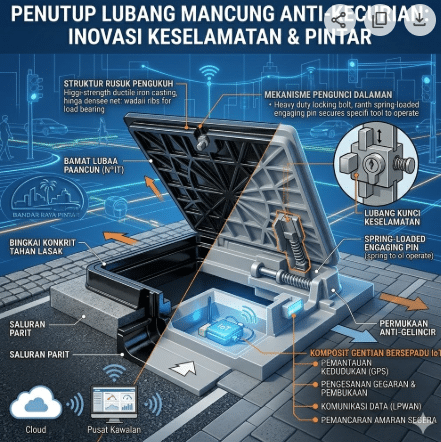
Modern international projects are increasingly prioritizing “Smart” and “Safe” features that go beyond basic load-bearing capacity. Anti-theft technology has moved past simple weight; custom covers now feature sophisticated locking mechanisms ranging from tamper-proof stainless steel bolts to “Cam locks” and unique patterned bolt heads that require specialized tools for access. In high-security environments like airports or power plants, electronic monitoring sensors can be embedded within the cover to alert authorities via IoT networks if a cover is moved or opened without authorization.
Noise reduction is another critical customization for urban residential projects. The metallic “clacking” of loose manhole covers is a major source of urban noise pollution and often indicates a poor fit that can lead to structural failure. Reliable manufacturers address this through precision machining and the integration of high-performance elastomeric gaskets or rubber seals. For instance, Singapore’s Land Transport Authority achieved a 60% reduction in noise at busy intersections by implementing a “triple-seal system” combining rubber gaskets, locking bolts, and beveled edges that allow vehicles to transition smoothly over the surface.
| Innovation | Technical Mechanism | Strategic Benefit |
| IoT Sensors | NB-IoT/GPRS real-time monitoring. | Prevents vandalism, detects floods & gas leaks. |
| Elastomeric Gaskets | Continuous rubber/silicone seals. | Soundproofing & vibration absorption. |
| Theft-Deterrent Locks | McGard ManLocks / Cam-locks. | Secures critical underground assets. |
| Anti-Slip Surfaces | Integrated checkering or SlipNOT® coating. | Enhances pedestrian & cyclist safety in wet weather. |
| Smart Monitoring | Temperature & water level alerts. | Enables predictive maintenance and flood prevention. |
The future of custom manhole covers lies in their integration into the Smart Grid. In cities like Dubai or Amsterdam, “Smart Manhole Covers” equipped with sensors monitor everything from sewage water levels and gas density to traffic vibrations. These sensors, optimized for low power consumption, can operate for over three years on a single battery, transmitting data to centralized municipal platforms. This proactive approach allows cities to respond to potential floods or infrastructure damage in 15 minutes rather than hours, transforming a static piece of iron into a vital pulse-point of urban intelligence.
Economic Analysis: Value Engineering vs. Initial Price
In the world of international infrastructure, the decision-making process must shift from “lowest bid” to “Total Cost of Ownership” (TCO). Low-cost manufacturers often use recycled scrap metal with inconsistent chemical ratios or bypass the critical heat-treatment phases that grant ductile iron its longevity. While these products may initially meet dimensional specs, they are prone to premature “dishing” (permanent center deflection) and cracking, which can lead to catastrophic accidents and expensive emergency repairs. A reliable manufacturer provides a product engineered for a 30- to 50-year service life, significantly reducing the annualized cost of the asset.
Value engineering in custom manhole covers also considers the “Human Element.” While a high-performance composite cover might have a higher unit price than cast iron, its lightweight nature can reduce installation labor costs by 50% and virtually eliminate long-term worker compensation claims related to manual handling. Furthermore, the inclusion of custom anti-slip textures and secure locking systems adds a layer of public safety that reduces municipal liability. By collaborating with a manufacturer that provides engineering adaptations and transparent technical support, procurement specialists ensure that their international project is protected against both environmental decay and financial risk.
Conclusion: Engineering the Cities of Tomorrow
The selection of custom manhole covers for international projects is a testament to the sophistication of modern civil engineering. By moving beyond the standard commodity mindset, project managers can leverage material innovations, global compliance expertise, and smart technologies to build more resilient and harmonious urban environments. A reliable manufacturing partner is not just a supplier but a strategic ally who understands that the integrity of a city’s infrastructure is only as strong as its weakest access point.
As we look toward the future of global urban development, the role of high-performance access solutions will only expand. From the integration of IoT sensors to the use of sustainable, theft-proof materials, the “humble” manhole cover is being redefined. By prioritizing technical excellence, regulatory transparency, and total lifecycle value, you ensure that your international project remains safe, secure, and ready to meet the challenges of the twenty-first century.
Frequently Asked Questions (FAQ)
1. How do I determine if my project needs EN 124 or AASHTO M306 standards?
The choice is typically determined by the project’s geographic location and the governing authority. Most international projects in Europe, the Middle East, and Asia follow the EN 124 class system (e.g., D400 for roads). Projects in the United States or those funded by North American agencies often require AASHTO M306, which focuses on specific highway proof-load tests.
2. Can I get custom logos or colors on my manhole covers for a city branding project?
Yes. Modern manufacturing allows for high levels of aesthetic customization. Stainless steel covers can be laser-cut with intricate motifs, and composite covers can be produced in various colors with permanent, UV-stable logos molded directly into the surface. This is increasingly popular for historic districts and luxury developments.
3. What are the benefits of choosing composite (FRP) over traditional ductile iron?
Composites are ideal for projects requiring lightweight handling, non-conductivity (for telecom/electrical), and corrosion resistance (for coastal/sewage environments). Crucially, they have zero scrap value, making them the best choice for regions with high metal theft rates. However, for extreme loads like airport taxiways (F900), ductile iron remains the preferred choice.
4. How long does the production of a custom manhole cover typically take?
For international orders, lead times usually range from 15 to 45 days. Standard designs with existing molds are faster, while bespoke sizes or those requiring custom logo molds may add 1 to 2 weeks to the schedule. It is vital to factor in an additional 3 to 6 weeks for international sea freight and customs clearance.
5. How can I verify the quality and reliability of an international manufacturer?
Always request a third-party Certificate of Conformity (CoC) and a Material Test Report (MTR) for each batch. A reliable manufacturer will have ISO 9001 certification and be open to a factory audit—either in person or via video—to demonstrate their casting precision, testing facilities, and quality control protocols.