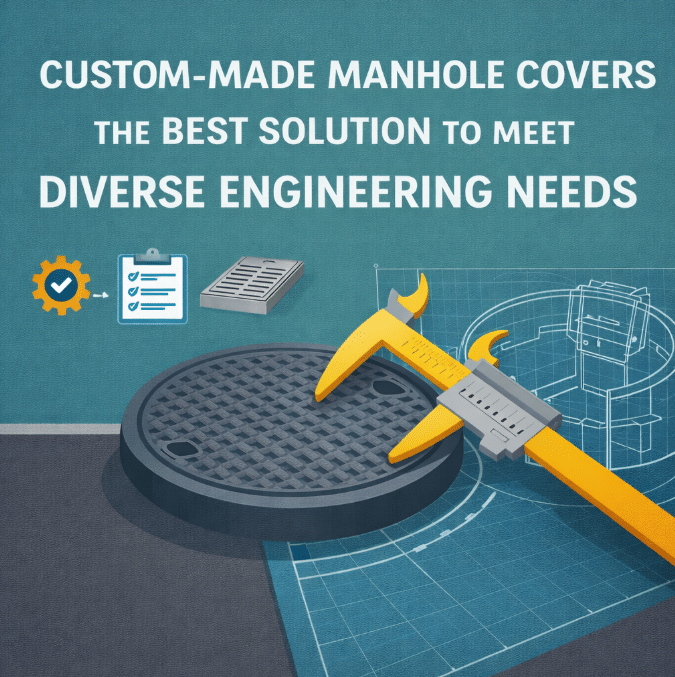
In modern urban infrastructure and industrial engineering, custom-made manhole covers play a far more critical role than many people realize. Beyond simply sealing access points to underground utilities, manhole covers must meet strict requirements related to load-bearing capacity, safety, durability, environmental adaptation, aesthetics, and regulatory compliance. Standard, off-the-shelf products often fail to address the unique challenges posed by different engineering projects, such as varying traffic loads, harsh climates, architectural integration, or special functional demands.
As cities expand and infrastructure systems become more complex, engineers, contractors, and municipal authorities increasingly recognize that custom-made manhole covers provide the flexibility and performance necessary to support long-term, sustainable development. By tailoring materials, dimensions, surface treatments, and structural designs, customized solutions help reduce maintenance costs, enhance public safety, and extend service life.
1. Why Custom-Made Manhole Covers Are Essential in Modern Engineering
Modern engineering projects rarely operate under uniform conditions. Urban roads, airports, industrial zones, residential areas, and public squares all impose different mechanical and environmental demands on infrastructure components. Custom-made manhole covers allow engineers to precisely match product performance with real-world operating conditions, rather than compromising with generic specifications.
Customization ensures that factors such as load class, opening size, frame height, and installation method align with project requirements. For example, a highway requires heavy-duty covers designed for continuous high-speed traffic, while a pedestrian plaza may prioritize slip resistance and visual integration. In both cases, custom-made manhole covers provide targeted solutions that improve safety and efficiency.
Additionally, customized designs help address local regulations and standards, which often vary by country or municipality. By aligning engineering design with regulatory compliance from the outset, project risks and approval delays can be significantly reduced.
2. Material Selection for Custom-Made Manhole Covers
One of the most important advantages of custom-made manhole covers is the ability to select materials based on performance, cost, and environmental conditions. Common material options include ductile iron, cast iron, composite materials, and stainless steel, each offering distinct benefits.
Ductile iron is widely used for heavy-load applications due to its excellent strength, impact resistance, and fatigue performance. Composite materials, on the other hand, offer corrosion resistance, lightweight handling, and theft deterrence, making them suitable for coastal or chemically aggressive environments. Stainless steel provides a clean appearance and high corrosion resistance, ideal for architectural or hygienic applications.
Through customization, engineers can also specify coatings, surface textures, and anti-corrosion treatments to enhance durability. This tailored material strategy ensures that custom-made manhole covers deliver optimal lifecycle performance while balancing budget considerations.
3. Structural Design and Load-Bearing Optimization
Structural design is at the core of effective custom-made manhole covers. Unlike standard products, customized covers can be engineered to meet precise load classifications, such as EN124 B125, C250, D400, or higher, depending on traffic intensity and usage patterns.
Design elements such as rib configuration, frame-to-cover contact surfaces, and locking mechanisms are optimized through CAD modeling and structural analysis. This approach minimizes stress concentration, reduces noise caused by movement, and prevents premature failure. In high-risk areas, anti-fall and anti-displacement designs further enhance safety.
By aligning structural performance with site-specific requirements, custom-made manhole covers contribute directly to road safety, infrastructure stability, and reduced maintenance intervention over time.
4. Manufacturing Process and Quality Control
The production of custom-made manhole covers involves a more sophisticated manufacturing process compared to standard items. It typically begins with detailed engineering drawings and 3D models, ensuring dimensional accuracy and functional compatibility with surrounding structures.
Advanced manufacturing techniques, such as precision casting, CNC machining, and controlled heat treatment, are used to achieve consistent mechanical properties. Throughout the process, strict quality control measures—including material testing, load testing, and dimensional inspection—ensure compliance with international standards.
Customization does not mean sacrificing reliability. On the contrary, tailored production often results in higher quality outcomes because each product is manufactured with a clear application context in mind. This approach reinforces trust between manufacturers, engineers, and project owners.
5. Application Scenarios Across Diverse Engineering Projects
Custom-made manhole covers are widely used across a broad range of engineering scenarios. In urban transportation networks, they are designed to withstand heavy traffic while maintaining surface stability. In residential developments, customized designs focus on noise reduction, aesthetics, and pedestrian safety.
Industrial facilities often require manhole covers resistant to chemicals, high temperatures, or vibration. Meanwhile, public spaces such as parks and plazas benefit from covers that blend seamlessly with architectural elements. In all these cases, customization ensures functional alignment with environmental and operational demands.
By adapting to diverse applications, custom-made manhole covers support infrastructure resilience and long-term operational efficiency across sectors.
6. Long-Term Economic and Sustainability Benefits
While custom-made manhole covers may have a higher initial cost compared to standard products, their long-term economic benefits are significant. Improved durability, reduced failure rates, and lower maintenance frequency translate into substantial lifecycle cost savings.
Customization also supports sustainability goals by optimizing material usage, extending service life, and reducing the need for frequent replacement. In addition, theft-resistant designs and corrosion-resistant materials help minimize environmental impact and operational disruptions.
From a strategic perspective, investing in custom-made manhole covers aligns infrastructure development with long-term performance, safety, and sustainability objectives.
Conclusion
Custom-made manhole covers represent the most effective solution for meeting diverse engineering needs in today’s complex infrastructure landscape. By offering flexibility in material selection, structural design, manufacturing precision, and application adaptation, customized solutions address the limitations of standard products.
For engineers, contractors, and municipal decision-makers, choosing custom-made manhole covers means investing in safety, durability, regulatory compliance, and long-term value. As infrastructure demands continue to evolve, customization will remain a key driver of innovation and performance in underground access systems.
FAQ
1. What are custom-made manhole covers?
Custom-made manhole covers are designed and manufactured according to specific project requirements, including size, load capacity, material, and environmental conditions.
2. Are custom-made manhole covers more expensive?
Initial costs may be higher, but reduced maintenance and longer service life often result in lower total lifecycle costs.
3. Which materials are best for custom-made manhole covers?
Common options include ductile iron, composite materials, cast iron, and stainless steel, selected based on application needs.
4. Can custom-made manhole covers meet international standards?
Yes, they can be designed to comply with EN124, ASTM, and other relevant international standards.
5. What projects benefit most from custom-made manhole covers?
Urban roads, industrial facilities, public spaces, and specialized infrastructure projects benefit significantly from customized solutions.
Meta Description (150 characters)
Short URL:https://www.example.com/
Main Keyword:
Related Keywords:
, engineering manhole covers,