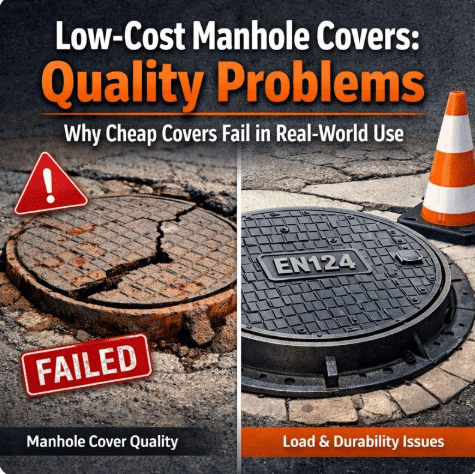
Manhole covers play a critical role in protecting underground utilities and ensuring the safety and reliability of urban infrastructure. Despite their relatively small size compared to larger civil engineering structures, manhole covers are subjected to constant mechanical stress, environmental exposure, and public safety demands. In recent years, growing budget constraints have led many infrastructure projects to consider low-cost manhole covers as a way to reduce upfront expenses. While this approach may appear economically attractive, it often introduces hidden quality issues that can result in long-term operational, safety, and financial risks.
Low-cost manhole covers are typically manufactured with reduced material quality, simplified production processes, or limited quality control. These compromises may not be immediately visible after installation, but they often emerge over time through premature wear, structural failure, or increased maintenance requirements. Understanding the most common quality issues associated with low-cost manhole covers is therefore essential for engineers, procurement managers, and municipal decision-makers who aim to balance cost efficiency with long-term infrastructure performance.
Inferior Material Quality and Inconsistent Composition
One of the most common quality issues in low-cost manhole covers is the use of inferior or inconsistent materials. To reduce manufacturing costs, some producers rely on low-grade cast iron, recycled scrap metal of uncertain composition, or insufficiently controlled alloy ratios. While these materials may meet basic dimensional requirements, they often lack the mechanical properties needed for long-term performance under traffic loads.
Inconsistent material composition can significantly affect strength, ductility, and fatigue resistance. For example, manhole covers made from poorly controlled cast iron may exhibit brittleness, making them more susceptible to cracking under dynamic loads. In urban road and highway environments, where covers are repeatedly subjected to heavy vehicles, braking forces, and vibration, such weaknesses can quickly lead to structural failure.
In contrast, higher-quality materials such as ductile iron are produced under strict metallurgical controls to ensure uniform performance. Low-cost alternatives often bypass these controls, increasing variability between batches and making performance less predictable. Over time, this unpredictability can translate into higher maintenance costs and increased safety risks.
Insufficient Load-Bearing Capacity
Load-bearing performance is a fundamental requirement for manhole covers used in roads and highways. Low-cost manhole covers frequently fail to meet the required load classes specified by international standards such as EN124 or AASHTO. In some cases, products are labeled with a load rating that has not been properly tested or certified, creating a false sense of compliance.
Insufficient load-bearing capacity may not cause immediate failure, but it often leads to gradual deformation. Covers may begin to flex, sink, or loosen within the frame, compromising both structural integrity and road surface stability. This deformation can accelerate pavement damage around the manhole, further increasing repair costs.
In high-traffic urban areas, inadequate load performance poses a serious safety hazard. Sudden collapse or displacement of a manhole cover can result in vehicle damage, traffic accidents, or injuries to pedestrians and cyclists. These risks far outweigh the short-term savings achieved by choosing low-cost products.
Poor Manufacturing Precision and Dimensional Inaccuracy
Another frequent issue with low-cost manhole covers is poor manufacturing precision. To minimize production expenses, some manufacturers rely on outdated molds, simplified machining processes, or limited inspection procedures. As a result, dimensional tolerances may be inconsistent, leading to poor fit between the cover and its frame.
Dimensional inaccuracies can cause several operational problems. Loose-fitting covers often generate noise when vehicles pass over them, which is a common complaint in urban environments. Over time, repeated movement can wear down the seating surface, further increasing instability and accelerating failure.
Poor fit also affects load distribution. When a cover does not sit evenly within the frame, stress concentrations develop at specific points, increasing the likelihood of cracking or breakage. These issues are particularly problematic on highways, where dynamic loads are both frequent and intense.
Inadequate Surface Treatment and Corrosion Resistance
Urban environments expose manhole covers to water, chemicals, road salts, and pollutants. Low-cost manhole covers often lack proper surface treatment or protective coatings, making them vulnerable to corrosion. While corrosion may initially appear as a cosmetic issue, it can significantly weaken structural integrity over time.
Inadequate corrosion resistance shortens the service life of manhole covers and increases the frequency of replacement. In drainage systems, corrosion can also interfere with proper seating and sealing, allowing water and debris to enter underground chambers more easily.
High-quality manhole covers typically use advanced coatings or material properties that resist corrosion in aggressive environments. Low-cost alternatives may skip these processes entirely or apply coatings inconsistently, resulting in uneven protection and accelerated deterioration.
Limited Quality Control and Testing Procedures
Quality control is a critical component of reliable infrastructure manufacturing. Low-cost manhole covers are often produced with minimal inspection and testing to reduce operational expenses. This lack of oversight increases the likelihood that defective products reach the market.
Without proper load testing, material verification, and dimensional inspection, manufacturers cannot consistently guarantee performance. For buyers, this creates uncertainty and increases project risk, especially in large-scale infrastructure developments where failure can have widespread consequences.
Reputable manufacturers invest in standardized testing and third-party certification to validate product performance. Low-cost suppliers may avoid these processes, making it difficult for buyers to verify claims or ensure compliance with regulatory requirements.
Long-Term Economic and Safety Implications
While low-cost manhole covers may reduce initial procurement costs, their long-term economic impact is often negative. Premature failure, frequent maintenance, and emergency repairs can quickly exceed the savings achieved at purchase. Additionally, indirect costs such as traffic disruption, liability claims, and reputational damage must be considered.
From a safety perspective, the risks associated with low-quality manhole covers are significant. Infrastructure failures can undermine public trust and place road users at risk. As cities aim to build more resilient and sustainable systems, short-term cost savings should not compromise long-term performance and safety.
Conclusion
Low-cost manhole covers may appear to offer an attractive solution for budget-constrained infrastructure projects, but they often introduce serious quality issues that compromise performance, safety, and long-term value. Inferior materials, insufficient load capacity, poor manufacturing precision, inadequate corrosion protection, and limited quality control are among the most common problems associated with these products.
For urban roads and highways, where manhole covers play a critical role in protecting underground utilities and ensuring public safety, quality should be viewed as a long-term investment rather than a short-term expense. By understanding the risks associated with low-cost options, decision-makers can make more informed choices that support durable, safe, and economically sustainable infrastructure systems.
Frequently Asked Questions (FAQ)
1. Why are low-cost manhole covers more likely to fail?
Low-cost manhole covers often use inferior materials and limited quality control, which reduces strength, durability, and resistance to long-term stress.
2. Are low-cost manhole covers compliant with international standards?
Some may claim compliance, but without proper testing and certification, actual performance may not meet EN124 or AASHTO requirements.
3. How does poor material quality affect manhole cover performance?
Inconsistent or low-grade materials reduce load-bearing capacity and increase the risk of cracking, deformation, and premature failure.
4. Can low-cost manhole covers increase maintenance costs?
Yes. Frequent repairs, replacements, and surrounding pavement damage often result in higher total ownership costs over time.
5. What should buyers prioritize when selecting manhole covers?
Buyers should prioritize verified load ratings, material quality, manufacturing precision, corrosion resistance, and certified quality control processes.