The integrity of urban infrastructure is often judged by the components that remain largely invisible to the public eye. Among these, manhole covers serve as the critical interface between the bustling surface world and the complex network of utilities, drainage, and communication lines that lie beneath. While historically manufactured from wood or stone, the advent of the Industrial Revolution introduced cast iron as the primary material for these access points. In the modern era, engineers and procurement specialists frequently search for common malleable iron manhole cover models to meet specific durability and safety requirements. However, the term “malleable iron” in contemporary industrial usage often encompasses a broader metallurgical spectrum, including ductile iron and high-performance gray iron castings.
Understanding the nuances of these materials, their standardized classifications, and the precise dimensional specifications is essential for ensuring the safety of pedestrians and the longevity of municipal assets. This report explores the various models available in the global market, the rigorous standards that govern their performance, and the emerging technologies that are transforming these static iron lids into active nodes of smart city infrastructure.
Metallurgical Foundations: Gray, Malleable, and Ductile Iron
The performance of a manhole cover is fundamentally determined by the arrangement of carbon within its iron matrix. Selecting the appropriate iron variant requires a deep understanding of how these materials respond to compressive and tensile forces, especially in environments subject to constant vehicular traffic.
The Characteristics of Gray Cast Iron
Gray iron, often identified as lamellar graphite iron, is the traditional standard for construction castings. Its name derives from the grayish hue of fractured surfaces, caused by the presence of carbon in flake form. These flakes provide excellent vibration damping and thermal conductivity, which are beneficial for components that must remain stable under shifting environmental conditions. However, from a structural perspective, these graphite flakes act as internal stress concentrators.
When gray iron is subjected to heavy tensile loads, the flakes facilitate rapid crack propagation, leading to a brittle failure mode. While gray iron remains highly effective for non-load-bearing applications or areas with light traffic, its lack of yield strength—meaning it breaks before it bends—makes it less ideal for high-speed roadways.
The Evolution of Malleable Iron
Malleable iron represented the first significant metallurgical advancement toward creating a “bendable” iron. It is produced by starting with white cast iron, which is then subjected to a prolonged annealing process at temperatures between 800°C and 900°C. This heat treatment causes the carbon to aggregate into “rosettes” or cottony clusters rather than flakes.
The resulting microstructure allows the material to deform plastically without breaking, providing much higher impact resistance than gray iron. Historically, malleable iron was the preferred choice for small tools, pipe fittings, and access covers that needed to withstand hammering or sudden shocks. However, the energy-intensive nature of the annealing process and the risk of internal shrinkage during cooling have led to its gradual replacement in larger castings by more modern alloys.
The Dominance of Ductile Iron
Ductile iron, also known as spheroidal or nodular iron, has become the industry benchmark for heavy-duty manhole covers. Invented in 1943, it achieves its unique properties through the addition of magnesium or cerium to the molten iron. These elements force the graphite to form into spherical nodules. These nodules distribute stress evenly throughout the matrix and effectively stop cracks from spreading.
Ductile iron offers tensile strength and elongation properties comparable to some carbon steels, yet it retains the excellent castability of iron. Because it can be cast into thinner, lighter sections than gray iron while maintaining superior strength, ductile iron covers are easier for field crews to handle, reducing the risk of workplace injuries.
| Performance Factor | Gray Iron (ASTM A48) | Malleable Iron (ASTM A47) | Ductile Iron (ASTM A536) |
| Microstructure | Graphite Flakes | Rosette-like Clusters | Spheroidal Nodules |
| Tensile Strength | 20,000 – 60,000 PSI | 50,000 – 53,000 PSI | 60,000 – 120,000 PSI |
| Yield Strength | Nearly Zero | 32,000 – 35,000 PSI | 40,000 – 90,000 PSI |
| Elongation | ~0% | 10% – 18% | 2% – 20% |
| Impact Resistance | Low (Brittle) | Medium-High | High |
| Typical Use | Drainage Grates | Hand Tools, Fittings | Heavy-Duty Roadways |
Global Regulatory Frameworks and Load Classifications
Selecting a manhole cover model is not merely a matter of choosing a size; it is a critical safety decision based on the load-bearing capacity required for a specific location. The most widely recognized standard for this classification is BS EN 124:2015, used throughout Europe and in many international markets.
The EN 124 Classification System
The EN 124 standard divides access covers into six classes based on static test loads. These classes correspond to the groups of installation locations, ranging from pedestrian walkways to airport runways.
| Class | Static Test Load | Equivalent Weight | Recommended Installation Area |
| A15 | 15 kN | 1.5 Metric Tons | Pedestrian areas, cycling paths, and private gardens. |
| B125 | 125 kN | 12.5 Metric Tons | Footways, pedestrian zones, and domestic driveways for cars. |
| C250 | 250 kN | 25 Metric Tons | Kerbside channels and road shoulders extending max 500mm into the road. |
| D400 | 400 kN | 40 Metric Tons | Road carriageways, highways, and hard shoulders for all vehicle types. |
| E600 | 600 kN | 60 Metric Tons | Docks, loading areas, and high wheel-load industrial zones. |
| F900 | 900 kN | 90 Metric Tons | Aircraft pavements and extreme heavy-duty logistics hubs. |
In the United States, the American Association of State Highway and Transportation Officials (AASHTO) provides alternative benchmarks, such as the H-20 and HS-20 loading ratings. An H-20 rating indicates the cover can support the 16,000-pound wheel load of a 20-ton truck, a standard requirement for most American municipal road projects.
The Importance of Compliance
Using an improperly rated cover can lead to catastrophic failure. A cover rated A15 installed in a driveway may survive the weight of a compact car, but it will likely cave in under the weight of a delivery van or emergency vehicle, potentially causing vehicle damage or pedestrian injury. Conversely, over-specifying (e.g., using an F900 cover in a garden) is economically inefficient. Procurement officers must balance safety requirements with budget constraints by strictly adhering to these standardized groups.
Analysis of Common Manhole Cover Models and Specifications
Models are primarily identified by their geometric shape, clear opening size, and duty rating. Manufacturers use standardized item codes to denote these specifications, allowing engineers to match the cover to the underlying maintenance hole structure.
Round Iron Manhole Cover Models
Round covers are the most frequent choice for sewage and drainage systems. Their circular geometry ensures that the lid cannot fall through its own opening regardless of orientation, and the absence of corners eliminates stress points that could lead to cracking under load.
| Model Number | Clear Opening (mm) | Frame Outer (mm) | Height (mm) | Typical Grade |
| MC-82 | 292 mm (11.5″) | 448 mm | 102 mm | Medium Duty |
| MC-200 | 508 mm (20″) | 635 mm | 70 mm | Standard Traffic |
| RESO PKSR | 600 mm | 840 mm | 100 mm | D400 Heavy Duty |
| KY-510 | 635 mm (25″) | 965 mm | 203 mm | Extra Heavy Duty |
| MC-900 | 1219 mm (48″) | 1435 mm | 152 mm | Large Industrial |
Square and Rectangular Manhole Cover Models
Square and rectangular models are often preferred for telecommunications vaults and electrical chambers because they align perfectly with modular paving or tile floors. Because stress concentrates at the corners, these models often feature reinforced ribbing or utilize ductile iron to achieve high load ratings without excessive weight.
| Item Code | Size (mm) | Load Class | Frame Outer (mm) | Approx. Weight (kg) |
| MS1 | 300 x 300 | A15 | 385 x 385 | 8 kg |
| MS4 | 450 x 450 | B125 | 590 x 590 | 45 kg |
| MS8 | 600 x 600 | C250 | 750 x 750 | 90 kg |
| MS17 | 600 x 600 | D400 | 775 x 775 | 105 kg |
| MR9 | 600 x 900 | C250 | 775 x 1070 | 150 kg |
| MR11 | 600 x 900 | D400 | 775 x 1070 | 170 kg |
Specialized Geometric Designs
One innovative model is the double triangular manhole cover. This design divides a square cover into two triangular halves that interlock. Based on the geometric principle that a triangle is inherently stable on three support points, these covers eliminate the “rocking” or “clattering” noise often heard when cars drive over loose rectangular lids. These models are highly effective for high-speed urban roads where noise reduction is a priority.
Advanced Performance Features
Modern iron manhole covers incorporate several design features to address specific urban challenges, ranging from environmental ingress to public safety.
Sealing and Gasket Systems
To prevent surface water from overwhelming sewer systems during heavy rain—a process known as inflow and infiltration (I/I)—manufacturers offer watertight models. These models feature machined bearing surfaces and high-quality neoprene or Buna-N rubber gaskets. By sealing the lid to the frame with stainless steel bolts, utilities can prevent costly sewer overflows and treatment plant surcharges.
Security and Anti-Theft Mechanisms
The high scrap value of iron makes manhole covers frequent targets for theft, leaving dangerous open shafts in public spaces. To combat this, modern models include integrated locking systems:
- Penta Bolts: Five-sided bolt heads that require specialized utility tools for removal, deterring casual theft.
- Hinged Designs: Covers that are permanently hinged to the frame, making them difficult to remove without heavy equipment.
- Magnetic Locking: High-security areas use electronic or magnetic pins that only release when triggered by a unique authorized device.
Surface Safety and Ergonomics
To protect pedestrians, the top surface of iron covers features cast-in anti-skid patterns, such as checkered or diamond plates. Additionally, for maintenance crews, features like recessed lifting points and “lay-in” styles with 1/2-inch pick holes allow for safe removal using standardized hooks, reducing the risk of musculoskeletal injuries.
Professional Installation and Maintenance Protocols
The effective lifespan of a ductile iron manhole cover can reach 50 years, but this longevity is entirely dependent on correct installation. A poorly seated frame creates uneven stress distribution, which eventually leads to road subsidence, rattling noise, and premature failure of the ironwork.
Engineering Steps for Frame Installation
Professional installation requires a systematic approach to ensure a monolithic bond between the iron frame and the maintenance hole shaft.
- Preparation: The top of the concrete chamber must be cleaned of all debris and mud. Roughening the surface is often recommended to improve the mechanical “key” with the bedding material.
- Bedding Mortar: Engineers specify high-strength, non-shrink mortars with a minimum compressive strength of 50 $N/mm^2$. For roads that must be reopened quickly, polyester resin-based mortars are used for their rapid curing properties.
- Leveling: The frame must be positioned within 5mm of the expected final road surface. Using spirit levels is mandatory to prevent tilting, which would cause dynamic traffic loads to “hammer” one side of the frame.
- Encapsulation: Bedding mortar should completely envelope the frame flange to a minimum depth of 10mm both below and above the flange. This ensures the frame is locked into the pavement structure.
- Curing: Traffic must be restricted until the bedding reaches its design strength, typically requiring at least 72 hours for standard mortar installations.
Preventive Maintenance Checklist
Regular maintenance is more cost-effective than emergency replacement. Infrastructure managers should implement a routine inspection schedule every 6 to 12 months.
| Component | Inspection Task | Corrective Action |
| Surface Pattern | Check for excessive polishing or wear. | Replace if skid resistance is lost. |
| Seating Area | Look for silt, pebbles, or debris. | Clear frame seat to prevent rocking. |
| Gaskets/Seals | Inspect for cracks, hardening, or missing sections. | Replace seal to maintain watertightness. |
| Moving Parts | Verify hinges and locks operate smoothly. | Apply corrosion-resistant lubricant. |
| Pavement Edge | Check for cracks in the surrounding asphalt. | Re-level frame and patch road surface. |
The Digital Transformation: Smart Manhole Infrastructure
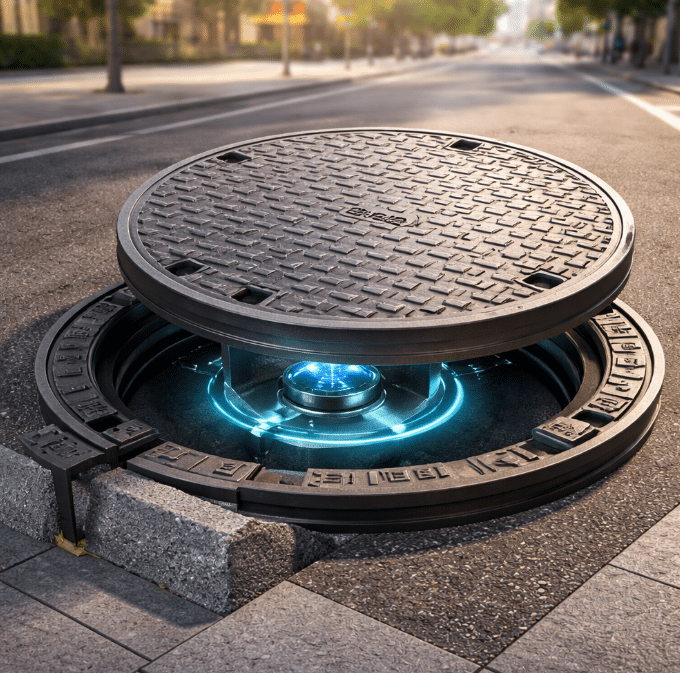
As cities transition to “Smart City” models, the humble manhole cover is being reinvented as a data gateway. Intelligent manhole cover monitoring systems integrate Internet of Things (IoT) sensors beneath the iron lid to provide real-time visibility into the underground environment.
Critical Sensor Technologies
Smart manholes address three primary urban challenges: flood prevention, public safety, and asset security.
- Ultrasonic Level Monitoring: Sensors detect rising water levels in sewers, providing early warnings for blockages or potential flooding before a surface event occurs.
- Hazardous Gas Detection: Continuous monitoring for Hydrogen Sulfide , Carbon Monoxide , and Methane protects utility workers and warns of potential explosions in the sewer network.
- Tilt and Tamper Alerts: Real-time sensors detect unauthorized openings or displacement, immediately notifying security personnel of potential vandalism or theft.
Connectivity and Power Management
These systems utilize Low Power Wide Area Network (LPWAN) protocols such as NB-IoT or LoRaWAN to transmit data through the thick iron cover to a centralized cloud platform. Because infrastructure is often in remote locations without power access, these devices are powered by lithium-ion batteries designed for 2 to 5 years of maintenance-free operation.
| Feature | Smart System Benefit | Economic Impact |
| Overflow Detection | Prevents sewer spills into public waterways. | Avoids environmental fines and cleanup costs. |
| Gas Monitoring | Ensures safe entry for maintenance crews. | Reduces workplace accidents and fatalities. |
| Asset Tracking | Locates covers and alerts to theft attempts. | Minimizes asset loss and public hazard liability. |
| Predictive Cleaning | Identifies blockages based on flow trends. | Optimizes labor and reduces unnecessary truck rolls. |
Strategic Procurement and Global Market Dynamics
The global market for iron manhole covers is heavily concentrated in industrial manufacturing clusters, with China serving as a dominant exporter. This dominance is based on structural advantages including large-scale casting capacity and strict compliance with international standards.
Specification-Led Buying Behavior
For B2B buyers, including municipal engineers and civil contractors, procurement is increasingly “specification-led” rather than “brand-led.” Buyers search for technical attributes—such as “D400 ductile iron 600×600” or “EN 124 C250 square cover”—to ensure the products meet the rigorous safety demands of their projects. Successful manufacturers build trust by making technical data sheets, ISO certifications, and detailed CAD drawings easily accessible on their digital platforms.
The Shift from Malleable to Ductile Iron
While “malleable iron” remains a popular search term, procurement officers should be aware of the market shift toward ductile iron. In many regions, ductile iron has almost entirely replaced malleable iron for manhole covers because it is cheaper to produce at scale and offers superior mechanical properties for the heavy loads of modern traffic. When reviewing catalogs, specifying ductile iron (Grade 500-7 or ASTM A536) often provides better long-term value and safety.
Future Outlook: Sustainability and Innovation
The trajectory of the manhole cover industry points toward high-performance materials and environmental responsibility. Manufacturers are exploring the use of 100% recyclable ductile iron to meet municipal sustainability goals. Simultaneously, the development of reinforced composite covers (SMC/FRP) provides a lightweight, zero-scrap-value alternative for areas where metal theft is chronic.
As extreme weather events become more frequent, the role of the manhole cover as a critical sensor for urban flood management will only grow. The transition from reactive maintenance—fixing things after they break—to predictive asset management will be driven by the integration of iron casting and digital sensor technology.
Conclusion
The selection of iron manhole covers is a foundational decision in urban engineering that impacts public safety, operational efficiency, and municipal budgets. From the metallurgical superiority of ductile iron to the rigid load classifications of the EN 124 standard, every specification serves a purpose in maintaining the integrity of our streets.
By prioritizing high-strength ductile alloys for heavy-traffic zones, adhering to professional installation protocols, and embracing the emerging potential of IoT monitoring, infrastructure managers can ensure that their subsurface access points remain secure and functional for decades. As urban environments continue to evolve, the integration of traditional iron craftsmanship with modern digital innovation will provide the resilience needed for the cities of tomorrow.
Frequently Asked Questions (FAQ)
1. What is the difference between malleable iron and ductile iron for manhole covers?
Malleable iron is produced through an annealing process that creates graphite rosettes, while ductile iron uses magnesium to create graphite nodules. Ductile iron is generally stronger, more cost-effective to produce at scale, and has largely replaced malleable iron for heavy-duty roadway applications.
2. How do I choose the correct load class for a manhole cover?
Selection is based on the installation location. A15 is for pedestrians only, B125 is for driveways, C250 is for kerbside channels, and D400 is for heavy-traffic roads. Always choose the class that matches or exceeds the highest expected vehicle load for the site.
3. Why are most manhole covers round instead of square?
Round covers are safer because they cannot fall through their own opening. They are also easier to machine for a tight fit, can be rolled for manual handling, and distribute traffic loads evenly across the frame without stress points.
4. What are the benefits of a “Smart” manhole cover?
Smart covers include sensors to monitor water levels, detect hazardous gases, and alert authorities to unauthorized opening or theft. This allows for predictive maintenance, flood prevention, and enhanced security for underground utilities.
5. How long does a ductile iron manhole cover typically last?
When installed correctly and maintained through routine inspections, a high-quality ductile iron manhole cover can last between 20 and 50 years, depending on traffic intensity and environmental conditions.