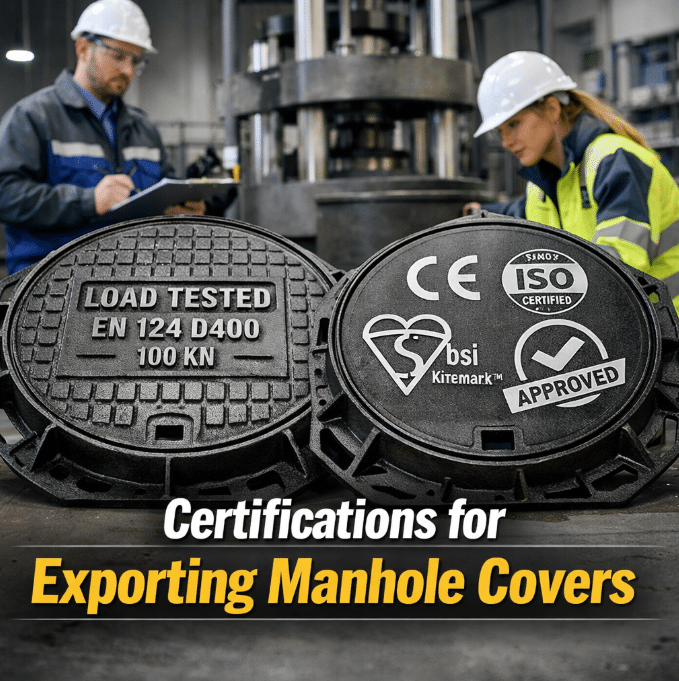
As infrastructure development accelerates worldwide, the demand for reliable and compliant manhole covers continues to grow across international markets. However, exporting manhole covers is not simply a matter of manufacturing and shipping products overseas. To legally enter foreign markets and be accepted by municipal authorities, contractors, and engineering firms, manufacturers must comply with a range of certifications required for exporting manhole covers.
These certifications ensure that manhole covers meet safety, performance, durability, and environmental standards specific to each region. Without proper certification, products may be rejected at customs, excluded from tenders, or pose serious liability risks. This article provides a comprehensive overview of the most important certifications required for exporting manhole covers, how they differ by market, and how exporters can prepare effectively for global trade.
Why Certifications Are Essential for Exporting Manhole Covers
Certifications serve as formal proof that a manhole cover has been tested and verified according to recognized technical standards. For importing countries, certifications protect public safety by ensuring that covers can withstand traffic loads, resist corrosion, and remain secure under long-term use.
For exporters, certifications are not only regulatory requirements but also commercial assets. Certified products gain credibility, improve tender eligibility, and shorten approval cycles for international projects. In many cases, large infrastructure projects explicitly require certified manhole covers as a condition for supplier qualification. As global trade becomes more regulated, certifications are no longer optional—they are fundamental to sustainable export growth.
EN 124 Certification: The European Standard
One of the most widely recognized certifications for manhole covers is EN 124, which applies across the European Union and many other regions that follow EU standards. EN 124 classifies manhole covers based on load-bearing capacity, ranging from A15 for pedestrian areas to F900 for airports and heavy-duty zones.
To obtain EN 124 certification, manhole covers must undergo rigorous testing, including static load tests, fatigue resistance evaluations, and dimensional accuracy inspections. Certification bodies verify not only product performance but also production consistency. For exporters targeting Europe, the Middle East, or Africa, EN 124 certification is often a mandatory requirement.
ASTM Standards for the United States and North America
In the United States and parts of North America, ASTM standards govern the quality and performance of manhole covers. Commonly referenced standards include ASTM A48 for gray iron and ASTM A536 for ductile iron manhole covers.
ASTM compliance focuses on material properties, tensile strength, elongation, and impact resistance. While ASTM standards may not always involve third-party certification in the same way as EN 124, buyers and municipalities frequently require laboratory test reports demonstrating compliance. Exporters entering the U.S. market must align product design and documentation with ASTM specifications to ensure acceptance.
ISO Certifications and Quality Management Systems
Beyond product-specific standards, ISO certifications, particularly ISO 9001 for quality management systems, play a critical role in exporting manhole covers. ISO 9001 certification demonstrates that a manufacturer maintains consistent production processes, quality control procedures, and traceability systems.
Many international buyers consider ISO certification a baseline requirement when selecting overseas suppliers. While ISO does not replace technical product certifications, it strengthens buyer confidence and supports long-term partnerships. For exporters aiming to scale globally, ISO certification is often seen as a strategic investment rather than a regulatory burden.
Environmental and Sustainability Certifications
With growing emphasis on sustainable infrastructure, environmental certifications are becoming increasingly relevant. Some markets require compliance with environmental management standards such as ISO 14001, while others may demand proof of recyclable materials or low environmental impact manufacturing.
For manhole cover exporters, environmental compliance enhances competitiveness, particularly in public sector projects funded by international organizations. Demonstrating responsible sourcing, reduced emissions, and waste management practices can significantly improve acceptance in environmentally regulated markets.
Testing, Documentation, and Certification Bodies
Obtaining certifications requires cooperation with accredited testing laboratories and certification bodies. These organizations conduct mechanical testing, material analysis, and factory audits to verify compliance.
Proper documentation is equally critical. Exporters must maintain test reports, certificates, technical drawings, and inspection records. Missing or inconsistent documentation can delay shipments or invalidate certifications. Establishing a systematic documentation process ensures smoother customs clearance and strengthens trust with international buyers.
Conclusion
Certifications required for exporting manhole covers are a cornerstone of successful international trade. From EN 124 and ASTM standards to ISO quality systems and environmental compliance, each certification serves a distinct purpose in ensuring safety, performance, and reliability.
For manufacturers and exporters, understanding certification requirements is not merely about regulatory compliance—it is about building credibility, accessing new markets, and securing long-term growth. By investing in proper testing, documentation, and certification strategies, exporters can position themselves as trusted global suppliers in the competitive infrastructure industry.
Frequently Asked Questions (FAQ)
1. Are certifications mandatory for exporting manhole covers?
In most markets, yes. Certifications are often required by law or specified in project tenders.
2. Is EN 124 accepted worldwide?
EN 124 is widely recognized, especially in Europe, the Middle East, and Africa, but not universal.
3. Can one certification cover multiple markets?
Some certifications overlap, but most markets still require region-specific compliance.
4. How long does certification take?
Depending on the standard, certification can take from several weeks to a few months.
5. Do certifications need renewal?
Yes. Many certifications require periodic audits or re-testing to remain valid.