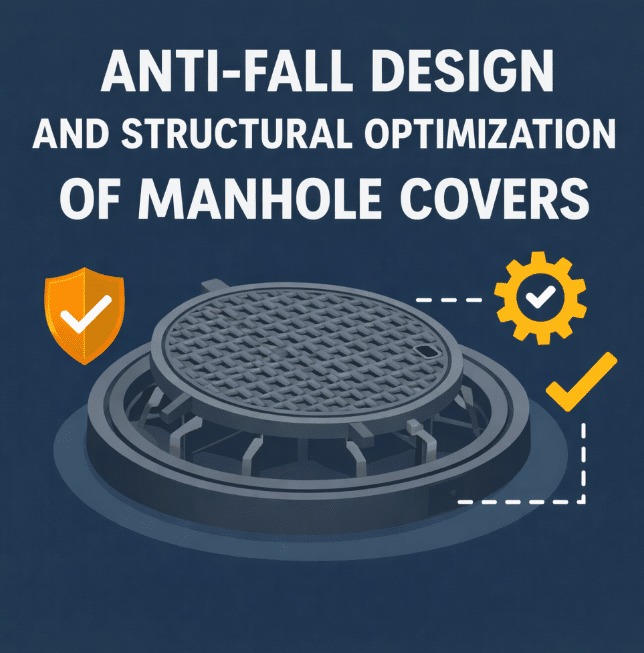
The safety performance of manhole covers is a critical yet often underestimated aspect of modern urban infrastructure. Among the many safety risks associated with underground access systems, accidental falls caused by dislodged, broken, or improperly designed manhole covers pose serious threats to pedestrians, cyclists, and vehicles. As cities expand and traffic density increases, the demand for anti-fall design and structural optimization of manhole covers has become a core engineering priority.
Anti-fall manhole cover design focuses on preventing covers from collapsing, tilting, or slipping into the chamber below under load or during maintenance. Structural optimization, on the other hand, ensures that the cover and frame system distributes stress evenly, resists fatigue, and maintains long-term stability. This article explores the engineering principles, design strategies, materials, and standards behind anti-fall manhole covers, offering practical insights for municipalities, engineers, and infrastructure planners seeking safer and more reliable solutions.
Understanding the Anti-Fall Risk of Manhole Covers
Manhole cover accidents often occur due to a combination of structural weakness, improper installation, and environmental degradation. Anti-fall design begins with understanding how and why failures occur in real-world conditions.
Traditional manhole covers may shift under repeated traffic loads, corrode at contact points, or lose alignment due to ground settlement. When the supporting frame fails or the cover fractures, the opening becomes an immediate hazard. Anti-fall risks are particularly severe in high-footfall areas such as sidewalks, public squares, and urban roads where exposure to pedestrians is constant.
From an engineering perspective, preventing falls requires addressing both vertical collapse and lateral displacement. A truly safe system must prevent the cover from dropping into the manhole even if the supporting structure is partially compromised. This concept forms the foundation of modern anti-fall manhole cover design.
Core Principles of Anti-Fall Manhole Cover Design
Effective anti-fall design relies on redundancy, mechanical interlocking, and controlled load transfer. These principles ensure safety even under unexpected conditions.
Mechanical Retention Systems
Anti-fall manhole covers often incorporate locking mechanisms, safety hinges, or secondary support ledges. These features prevent the cover from falling into the opening when lifted or damaged. Hinged designs are especially effective in maintenance scenarios, reducing worker risk.
Frame and Cover Integration
Structural optimization emphasizes precise tolerances between the cover and frame. A well-integrated system distributes loads evenly and minimizes vibration. Poor fit increases wear, leading to deformation and eventual failure.
Fail-Safe Structural Geometry
Anti-fall covers are designed so that even if the cover cracks, its geometry prevents total collapse. Rib reinforcement, tapered edges, and stepped support surfaces contribute to this fail-safe behavior.
Structural Optimization for Load Distribution and Stability
Structural optimization enhances both safety and durability by improving how forces act on the manhole cover system.
Load Path Optimization
Optimized designs ensure that vehicle loads are transferred from the cover to the frame and then into the surrounding pavement without creating stress concentrations. This reduces fatigue cracking and subsidence.
Rib and Reinforcement Design
Modern manhole covers use advanced rib patterns designed through finite element analysis (FEA). These ribs increase stiffness without excessive weight, improving load-bearing capacity while maintaining handling efficiency.
Material Thickness and Geometry Balance
Rather than simply increasing thickness, structural optimization focuses on strategic reinforcement. This approach reduces material waste while maintaining high safety margins.
Materials and Their Role in Anti-Fall Performance
Material selection directly affects anti-fall reliability and structural integrity.
Ductile Iron Manhole Covers
Ductile iron remains the most widely used material due to its excellent strength, toughness, and deformation resistance. Its ability to absorb impact energy makes it ideal for anti-fall applications.
Composite Manhole Covers
Advanced composite materials offer corrosion resistance and reduced weight while still meeting anti-fall requirements. When engineered correctly, composite covers include internal steel frames or reinforced fibers that prevent catastrophic failure.
Surface Treatments and Coatings
Anti-slip coatings, corrosion-resistant finishes, and wear-resistant layers extend service life and maintain dimensional stability, indirectly supporting anti-fall performance.
Anti-Fall Design Standards and Certification Requirements
Compliance with international standards ensures that anti-fall designs meet proven safety benchmarks.
EN 124 Load and Safety Standards
The EN 124 standard defines load classes and structural performance requirements. Many anti-fall manhole covers are certified under D400 or higher, ensuring safety in heavy traffic areas.
Anti-Theft and Safety Lock Standards
In some regions, anti-fall design overlaps with anti-theft requirements. Locking systems must balance accessibility with security, ensuring covers remain in place under all conditions.
Testing and Quality Control
Drop tests, load cycling tests, and impact simulations verify that anti-fall systems perform reliably over time. Quality-controlled manufacturing is essential for consistent safety outcomes.
Practical Applications and Urban Safety Benefits
Anti-fall manhole covers are especially important in environments where public safety is paramount.
Urban Roads and Highways
On busy roads, structural optimization prevents cover displacement caused by heavy vehicles. Anti-fall designs reduce accident risk and maintenance disruptions.
Pedestrian Zones and Public Squares
In public spaces, even minor cover instability can cause serious injuries. Anti-fall manhole covers provide peace of mind and reduce liability for municipalities.
Industrial and Utility Areas
In industrial zones, anti-fall designs protect workers during inspections and maintenance, improving occupational safety.
Anti-fall design and structural optimization of manhole covers represent a critical advancement in urban safety engineering. By integrating mechanical retention systems, optimized structural geometry, and high-performance materials, modern manhole covers significantly reduce the risk of collapse and displacement. As cities continue to evolve, prioritizing anti-fall safety is no longer optional—it is essential for protecting lives, reducing infrastructure costs, and ensuring long-term reliability. Investing in optimized, certified manhole cover systems is a proactive step toward safer, smarter urban environments.
Frequently Asked Questions (FAQ)
1. What is an anti-fall manhole cover?
An anti-fall manhole cover is designed to prevent the cover from dropping into the manhole, even if damaged or improperly seated.
2. Why is structural optimization important for manhole covers?
Structural optimization improves load distribution, reduces fatigue, and enhances long-term safety and durability.
3. Are hinged manhole covers safer?
Yes, hinged designs reduce accidental falls during maintenance and prevent cover displacement.
4. Which material offers the best anti-fall performance?
Ductile iron is widely regarded as the most reliable material due to its strength and toughness.
5. Do anti-fall manhole covers require special maintenance?
They require routine inspection, but optimized designs typically reduce long-term maintenance needs.